Extreme electrical strain is placed on indoor and outdoor HVAC units during peak heat due to continuous cooling operation. If your system runs for hours on end, its innards are put under a lot of stress. Sudden warm airflow or a humming sound from your outdoor unit often indicates a failing ac capacitor that keeps your compressor and fan from running correctly. In this guide, we’ll talk about how capacitor failures impact system efficiency and how to recognize technical early warning signs and what can be done to restore reliable cooling.
The function of an AC capacitor in the performance of the system
An air conditioner capacitor is a small electrical device that stores and gives off energy to assist in starting and operating your system’s motors. It’s a bit like a short surge of power to give the compressor and fan motor the boost they need to start up. Without this stored charge, the motors have a hard time overcoming their own resistance when they start up.
This release of stored energy is sometimes called electrical torque. In simple terms, it is the extra force needed to get a motor moving from a standstill. A good capacitor will give this push immediately and regularly every time your AC kicks on. When the capacitor weakens, that force drops, and the motor has to work harder just to begin turning.
The first thing that fires when your thermostat calls for cooling is the capacitor. It gives the compressor and fan motor a good kick before settling down to steady support. This happens dozens of times per day during hot months. That is why capacitors wear out faster than most people expect.
Understanding Start vs Run Capacitors in Cooling Units
Air conditioners generally have two types of capacitors and each serves a different purpose. A start capacitor gives a quick burst of high energy to get the compressor spinning from a standstill. It disconnects when the motor is at normal speed.
A run capacitor is another matter. It is connected during the entire operation of the unit, so that the motor can draw electrical current safely and effectively. It runs continuously so it starts to wear out slower but it still doesn’t last forever.
Here’s how to tell them apart quickly:
- Start capacitors are usually smaller and only work for a second or two as the motor is starting up
- Run capacitors are larger and operate through the whole cooling cycle
- A bad start capacitor is often the cause of hard starting or repeated attempts to start
- A bad run capacitor can cause weak airflow or cause the system to shut off during the cycle
Common Technical Causes Behind AC Capacitor Failure
It is very rare for a capacitor to fail suddenly without warning signs building up over time. Knowing what really hurts an ac unit system capacitor can help you catch problems before they turn into bigger ones. Most failures are due to heat, electrical stress or just age and knowing the difference is important in diagnosis.
How High Ambient Heat and Voltage Fluctuations Damage Components
Every capacitor has a rated capacity given in microfarads. Over time, exposure to heat will reduce this rating below the manufacturer’s specification. If the capacitor can’t hold its rated charge, it can’t deliver the power needed to properly start and run the motor.
This problem gets worse by voltage spikes. Surges from the grid or nearby electrical equipment can cause sudden stresses in the internal dielectric material of the capacitor. This is the stuff that holds the electrical charge. Repeated stress destroys it faster than it would normally age.
Several factors accelerate this electrical wear on an aircon capacitor:
- Unstable power supply causing voltage surges frequently
- Continuous cycling on and off during peak demand periods
- Heat trapped around the outdoor unit due to poor airflow
- Direct sun exposure causing internal cabinet temperature to rise
Symptoms of a Blown AC Capacitor
Before a blown ac capacitor goes completely bad, it often shows some obvious physical and audible symptoms. Picking these up early can save you from a complete system failure in the middle of the day.
Watch for these common indicators:
- AC unit has trouble turning on, and it tries to start multiple times
- Clicking or buzzing noise from the outdoor unit
- Fan does not start when compressor is running
- Blowing warm air out of vents even when the thermostat is set
- Capacitor case with a bulge or rounded top visible
- Burning smell near the electrical panel of the outdoor unit
Direct Impacts of a Bad Capacitor on System Cooling
When a capacitor fails, the effects ripple through the whole cooling process. The compressor loses the torque it needs to efficiently compress refrigerant, and that immediately reduces your system’s ability to cool. Even when the thermostat is set to the right target temperature, you’ll feel the air is warmer than it should be.
Another common result is fan motor drag. Bad ac capacitor symptoms often include a fan that spins slowly or stutters instead of running at full speed. This reduces the amount of air that can flow over the coils, meaning less heat is removed from the air passing through your system.
These problems also lead to irregular cooling cycles. The system might short cycle, turning on and off more often than it should as it tries to reach the desired temperature. This erratic operation causes a large increase in energy draw, as the compressor and fan motor draw more current trying to compensate for the weakened capacitor. The comfort change is often not noticed before your utility bill goes up.
Step-by-Step Guide to Identifying AC Capacitor Issues
You don’t need fancy equipment to diagnose a capacitor problem, but you do need to look closely. Following these steps in sequence helps you determine whether the capacitor is the source of your cooling issues.
Listen for humming without startup. If you can hear the compressor trying to kick on but the fan never turns, it is a direct sign of a capacitor that is not able to provide enough starting torque.
Check for bulges, leaks. First, shut off power to the unit and look at the capacitor casing. If the top bulges or there is oil around the base, the unit has internally failed.
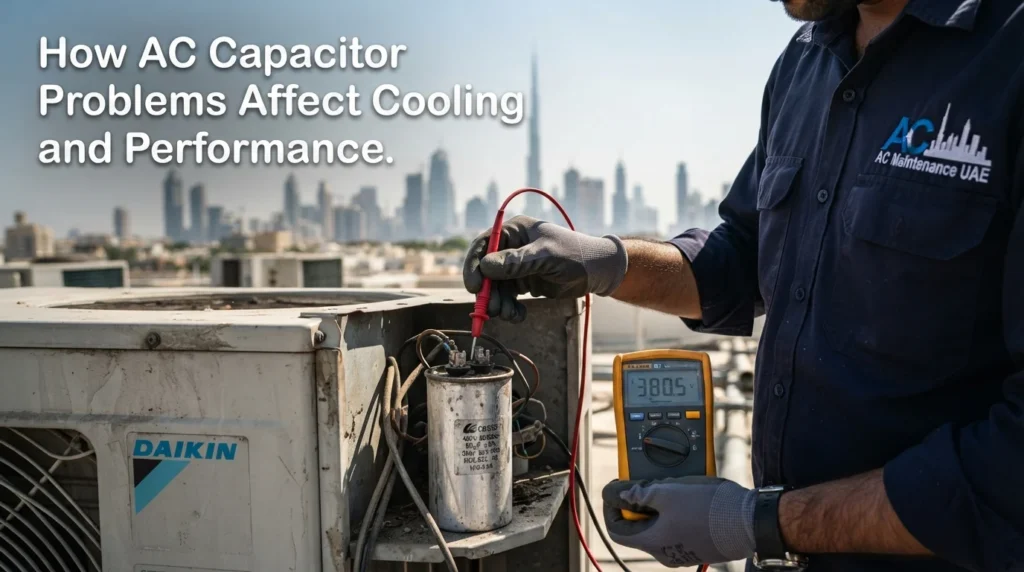
Check with a multimeter. Look at the actual microfarad reading and compare it to the rated capacity of the capacitor printed on its label. If it’s 10 percent or more under rated capacity, it needs to be replaced.
Inspect wiring connections. Loose or corroded wires can act like a bad capacitor, so this can help you rule out an easy electrical fix.
Check for any burned smell. A strong electrical burning smell from the outdoor unit usually indicates that the capacitor has already failed internally.
Wiring and Electrical Issues: Checking the AC Capacitor Connection
A loose ac capacitor can cause symptoms that are almost the same as capacitor failure, so it’s a step that’s easy to miss. Loose terminals cause the same hard starting or humming problems because they decrease the amount of current reaching the motor.
Before assuming the capacitor itself is bad, check these connection points:
- Terminal screws feel loose when softly tested
- Corrosion build-up (green or white) around wire connectors
- Wires that appear frayed, discolored, or partially melted
- Signs of arcing, such as small burn marks around the terminals
Always cut power at the breaker before touching any wiring near the capacitor.
How Extreme Dubai Heat Accelerates Capacitor Wear
Regions with extended high ambient temperatures add additional stress to outdoor HVAC components year round. In Dubai, outdoor units are often left exposed to direct sunlight all day, with cabinet temperatures rising well above ambient air temperature. This constant heat exposure minimize the expected life of a capacitor compared to a milder climate.
Capacitors in this region, between the high heat and near constant operation, do not often get a break to cool between cycles. If they never get a rest period, even the best built components will wear out faster. This cumulative stress, over a number of summers, adds up, and forces capacitors to failure sooner than their rated service life would suggest.
We often see this pattern of heat driven wear and AC Maintenance UAE technicians see a spike in capacitor related breakdowns during the hottest months. A pre-summer AC maintenance check can detect a capacitor that’s starting to fail before it actually fails during a heatwave, when it’s most difficult to schedule repair appointments quickly.
Differences in Split AC Capacitor and Window AC Capacitor Setup
The outdoor condensing unit has a split ac capacitor which is exposed to direct heat and weather conditions throughout the year. The outdoor unit is outside of the living space so checking or replacing this capacitor usually requires access to an exterior panel.
By way of comparison, a window ac capacitor comes in a single compact unit that fits into a window frame. This placement allows the capacitor a little more protection from direct sunlight but also closer proximity to the compressor and fan motor in a more condensed space that can hold heat differently.
Central Air Conditioner Capacitor Failures in Large Systems
A central air conditioner capacitor generally handles a higher electrical load than those in smaller split or window units. In central systems, multiple zones can be cooled together. This means the compressor will draw more current on startup and require more from the capacitor.
In a central system if a capacitor goes bad it affects the whole house or building and not just one room. This makes early detection especially important, as a full system failure in the height of summer impacts far more occupants and often costs more to repair urgently.
When Should You Schedule Professional AC Capacitor Repair?
Some capacitor problems are safe to check visually, but actually replacing them means working with stored electrical charge and this is a real risk if you don’t know what you are doing. If you’re trying to fix it yourself, there are some warning signs it might be time to call in a professional.
Watch for these red flags that call for expert ac capacitor repair:
- Capacitor has failed multiple times in the same cooling season
- You smell burning along with any electrical component
- Wiring around the capacitor seems to be exposed or damaged
- Basic checks have been done and the system still does not cool correctly
AC Maintenance UAE trained technician can discharge the capacitor safely, confirm that the correct replacement rating is used and check neighboring components for related wear.
Key Takeaways
A bad ac capacitor affects the compressor’s ability to start smoothly which decreases its total cooling torque. The same failing causes drag on the fan motor, slowing airflow over the coils and reducing the total cooling output of your system. If not corrected, all these small electrical problems add up over time with repeated cycles.
This prevents the kind of sudden breakdown that leaves you without cooling during the hottest part of the day. Catching capacitor wear early, through humming sounds, hard starting, or visible bulging, will save you from this problem. It also protects your compressor and fan motor from the added stress that eventually leads to costly motor burnout. The easiest way to avoid an unexpected system failure is still regular inspection during high heat months.
FAQs
Q: What is an AC capacitor?
An AC capacitor is an electrical component that stores and releases energy to help start and run the compressor and fan motor. It provides a short term source of power for run capacitors at startup and during continuous operation.
Q: What does an AC capacitor do?
It supplies a short burst of electrical energy to help the compressor and fan motor get past the resistance they meet when they first start up. Run capacitors help the motors run efficiently by providing a constant flow of current while the system is operating.
Q: How to replace an AC capacitor?
The first step is to disconnect the power and safely discharge the capacitor, because it can store a dangerous charge. The technician replaces it with one of the same microfarad and voltage rating, and reconnects the wiring.
Q: How often do AC capacitors go bad?
Most capacitors have a life duration of five to ten years, but this will depend on climate and use. Units in hot areas like Dubai usually fail earlier due to the constant heat and heavy cycling.
Q: How to check if an AC capacitor is bad?
Check the casing for bulges, listen for humming without startup, and check the microfarad reading with a multimeter. A reading well below the rated capacity will verify the capacitor needs replacing.
Q: How do I tell if my AC capacitor is bad?
Typical symptoms include hard starts, a humming compressor that the fan doesn’t move, and warm air even when the thermostat is set normally. A physically obvious indicator is a capacitor casing which appears to be visibly bulging.
Q: Will AC still run with a bad capacitor?
It may start and stop, or have difficulty starting, but the performance will be much reduced. Eventually the motor can overheat trying to compensate, risking permanent damage if the capacitor is not replaced soon.
Q: How long does an AC capacitor last?
The normal duration of life is usually between five and ten years. Extreme heat, frequent cycling, and voltage instability can shorten this very much, sometimes by half.
Q: Can I run my AC without a capacitor?
No. The capacitor stores the energy which the compressor and fan motor need to start rotating. Without it the motors switch on almost never, or are badly forced to start unassisted.
Q: How long does it take to change a capacitor on an AC unit?
A simple capacitor replacement takes a trained technician 30 to 60 minutes usually. This involves the proper disposal of the old unit, the installation of the new unit and the test system startup.
Q: Why does my outdoor AC unit hum but not start?
This humming often indicates the capacitor is unable to provide enough starting torque to the compressor or fan motor. The motor turns over but doesn’t catch, humming along slowly, but not starting normally.
Q: Does extreme heat shorten AC capacitor lifespan?
Yes, the internal materials degrade faster in high ambient temperatures than in moderate climates. This is especially true in locations like Dubai where outdoor units are subjected to extreme heat for most of the year.

AC Maintenance UAE Team
Welcome to AC Maintenance UAE, your reliable partner for complete air conditioning repair and maintenance services in Dubai, Sharjah, and Abu Dhabi. We are strongly dedicated to excellence and deliver efficient and reliable services to keep your cooling systems performing at their best.