There are few things worse than your AC blowing warm air on you in the middle of a Dubai summer afternoon, when you need it most. The majority of homeowners assume the compressor is broken, or the refrigerant is out. But the real problem is often much simpler. Imagine a dirty outdoor ac condenser coil like an insulating blanket wrapped around your system, trapping the heat that should be released to the outside. In this guide, we’ll break down exactly how a clogged coil affects your cooling, the signs you should never ignore, and the fixes that get your system back to peak performance.
How a Dirty Condenser Coil Disrupts Heat Dissipation
Your AC system absorbs heat from inside your home and releases it outside through the AC condenser coil. When this coil is clean the refrigerant passes freely through it and heat exchange occurs as it should. And when dust and dirt begin to coat the surface, that process breaks down quickly.
The pressure of the refrigerant is used by the coil to transfer heat between the indoor and outdoor units efficiently. In normal operation the hot refrigerant enters the coil, passes through the aluminum fins and dumps its heat to the outside air. This keeps the pressure even and the system running smoothly.
When the coil surface is covered with dust and dirt, it restricts airflow and stops proper heat transfer. The system is unable to dump heat at the rate it needs to . So the refrigerant remains hotter for longer than it should . This adds to the head pressure inside the system in a direct manner, which makes every component downstream work harder than it was meant to.
The Role of Refrigerant Pressure in Cooling
Refrigerant is the fluid that takes heat out of your home. It takes heat from the indoor air and transports it to the outdoor unit, where the air conditioner condenser coil releases that heat to the surrounding environment.
If the coil is dirty or blocked, the refrigerant cannot properly remove its heat. There is no place for the heat to go so pressure inside the system increases. If this pressure increases over time, it can stress all the parts of the refrigeration cycle, not just the coil.
Why Airflow Restriction Makes the Problem Worse
Dust layers in physical contact with the coil fins prevent air flow over the fins. If the surface has debris, even a fan running at full speed can not push air through it. This turns a small maintenance bug into a system-wide performance issue.
Common causes of airflow restriction include:
- Dust and sand carried by wind
- Pet Hair Collecting Near outdoor unit
- Seasonal buildup of pollen
- Construction debris from local sites
- Particles of grease blown from nearby kitchen exhausts
Warning Signs of a Clogged AC Condenser Coil
A clogged coil does not often fail silently. Homeowners usually notice performance issues such as weaker cooling and longer run times, combined with visible dirt on the outdoor unit. Spotting these signs early can save you from a much larger repair bill later.
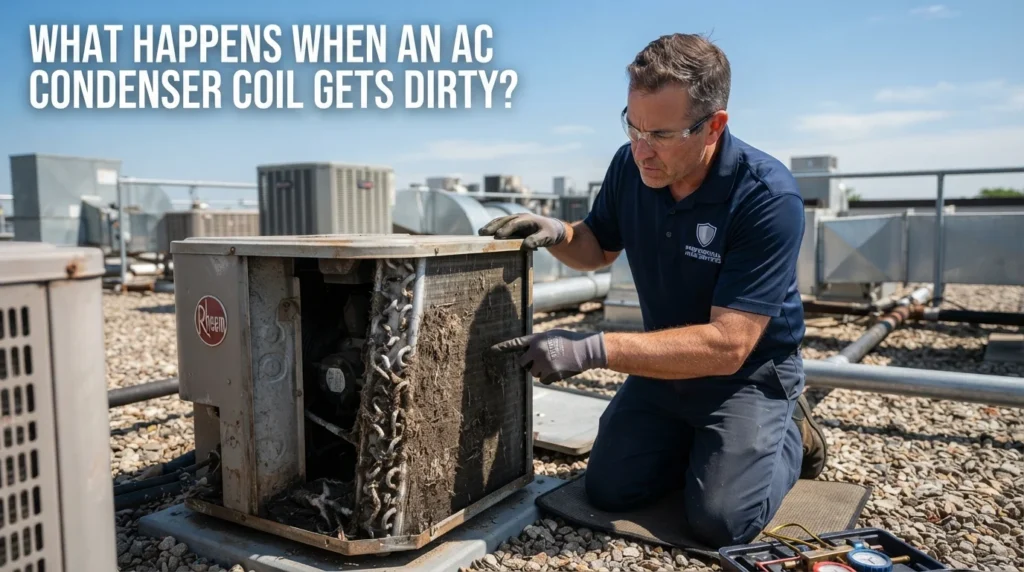
You’ll see a film of dust or dirt on the fins, discoloration on the coil surface, and debris caught between the metal ridges. Indoors, performance signs appear, often before anyone even looks at the outdoor unit.
Is Your AC Blowing Warm or Weak Air?
If your system is feeling like it’s struggling to keep up, the coil is a likely place to start. Look for these common symptoms:
- Low thermostat settings mean less cooling
- Long cooling cycles that don’t quite hit the target temperature
- Warm air gusts with cool air flow
- Difference in room temperature
- Weird rattling or humming noises coming from outside unit
Rising Power Bills: A Hidden Symptom of a Dirty Coil
When the ac condenser coil is dirty the compressor has to work harder to push heat out of the system. The added load translates directly to more electrical consumption, sometimes with no apparent change in the sound or feel of the AC.
Most homeowners don’t realize anything is wrong until their monthly bill suddenly jumps. At this point, it makes sense to compare the price of a new AC condenser coil with the price of a simple cleaning service. It is almost always cheaper to prevent than to replace.
Short-Cycling Risks Explained
Short-cycling happens when the AC turns on and off more frequently than it should, without completing a full cooling cycle. This is due to a dirty coil. The system heats quickly and shuts down as a safety measure before powering back up shortly after.
This on and off cycle is much more damaging to the compressor than normal use. Every time a unit is turned on, it causes an electrical surge and puts mechanical stress on the components, so frequent cycling on and off seriously decreases the life of expensive parts.
Step-by-Step Internal Damage Caused by a Dirty Coil
If you ignore a dirty coil, it’s not just weaker cooling. The problem snowballs in stages, from minor inefficiency to serious mechanical failure if left untreated too long.
Stage 1: Reduced Efficiency and Thermal Overload
At the earliest stage, the system just works harder to achieve the same cooling result. This is called thermal overload. Parts are driven beyond their design simply to keep up with demand . Energy bills start to creep up and comfort levels start to drop.
Stage 2: Compressor Strain and Overheating
If the coil remains dirty, the high head pressure becomes sustained and begins to directly stress the compressor motor. The compressor is the most expensive part of any AC unit and constant overheating shortens its life cycle. Many expensive repairs have their roots in damage that began at this very stage.
Stage 3: Refrigerant Leak Risks
An ac condenser coil leak will eventually result from prolonged pressure imbalance. The constant stress makes it easier for corrosion to develop. Weakened joints or fin damage create openings where refrigerant slowly leaks out. A leak further reduces the cooling capacity, and then you’ve got another repair bill to pay.
Stage 4: Complete System Failure
If left unresolved, total compressor burnout can result from a combination of overheating, pressure imbalance and refrigerant loss. At this stage it is usually not possible to repair and a complete new system is the only realistic solution. What begins as a simple cleaning issue becomes one of the most expensive AC problems a homeowner can have.
Local Dubai Environmental Factors That Accelerate Coil Damage
In UAE weather conditions coil fouling is much faster than mild climates. Sand, fine dust and humidity all combine to create buildup that clogs the coil much faster than expected.
Why Sand and Dust Build Up Faster in the UAE
In Dubai, sandstorms are frequent and there is constant construction work in many neighborhoods. Fine particles from both sources settle on outdoor units all the time and coils here require more frequent attention than in less dusty areas.
Humidity Crusting on Condenser Fins
The high humidity combined with the airborne dust forms a crusty layer on the fins that gets harder to scrub off the longer it is allowed to sit. This crust has a different effect on the air conditioner condenser coil than dry dust because moisture causes particles to bond tightly to the metal surface, and simple rinsing becomes far less effective over time.
Safe DIY Checks vs Professional Coil Cleaning
Some coil maintenance is safe for the homeowner to do himself, and some really do require a trained technician. Knowing the difference helps keep you and your system safe.
Simple DIY Checks Homeowners Can Do
You can safely handle a few basic maintenance steps on your own:
- Visually check the coil for visible dirt or debris
- Clear the unit of leaves, grass and other loose material
- Rinse gently with a garden hose on low pressure
- Make sure there is enough space around the unit for airflow
For dirt on the surface, use an ac condenser coil cleaner that’s mild and safe for coils, but avoid any harsh chemicals that could harm the fins.
When to Call a Professional Technician
Deep cleaning is more than most homeowners should attempt on their own. Professional AC cleaning is a safer option when the coil has heavy dirt or buildup that cannot be removed with basic rinsing. Bent fins, electrical components and refrigerant lines are all very real dangers if not handled properly. Don’t use the wrong tools to clean condenser coil ac parts or you could permanently bend fins or risk electric shock.
Professional ac condenser coil cleaning dubai services use specialized equipment that removes crusted grime without damaging delicate parts. AC Maintenance UAE suggests that you schedule a professional check-up if you notice any of the above warning signs. Early detection of issues keeps the repair costs under control.
Conclusion
A dirty ac condenser coil sometimes presents itself with one obvious symptom. Instead, it develops slowly as energy is lost, electricity bills increase and the compressor is forced harder and harder. Left unchecked, this stress can lead all the way to total compressor failure, turning a simple cleaning job into one of the most expensive repairs an AC system can have.
Regular inspection of the coils is still one of the easiest ways to prevent this, especially in the high ambient temperatures of Dubai when the system is already running at its limits. You can do the simple checks yourself or call in AC Maintenance UAE to do a detailed clean but preventing dust from building up will keep you comfortable and save your budget during the summer months.
FAQs
Q: What is the AC condenser coil?
This is the outdoor portion of your AC system that releases the heat it takes out of your home into the outside air. It takes the heat from the air inside and then it runs through the coil. This coil is surrounded by aluminum fins so that the heat can be released efficiently and the cooling cycle is finished.
Q: How long do AC condenser coils last?
Proper maintenance can help a condenser coil last 10 to 15 years. If you don’t clean it, you might lose some years, especially in rough environments like dust and humidity in Dubai. A long life requires regular grooming.
Q: How do I know if my condenser coil is bad?
Common signs include poor cooling, longer run times, visible dirt or corrosion, strange noises and rising electricity bills. When the thermostat settings are in the normal range, the coil is usually the culprit for a drop in cooling performance.
Q: How much does it cost to replace an AC condenser coil?
Replacement cost depends on the size of the unit, the brand, and labor charges, but coil replacement is usually much more expensive than routine cleaning. Getting a professional inspection done early will usually prevent the need for full replacement altogether.
Q: How much is an AC condenser coil?
Pricing is based on the tonnage of your system, the brand and the coil material. To get the most accurate estimate, ask local technicians for quotes, since exact costs vary wide between residential and commercial units.
Q: How often should an AC condenser coil be cleaned in Dubai?
Because of the sand and dust levels in the UAE, experts recommend cleaning every 3-6 months. Units near construction sites or in coastal areas may need to be checked more frequently to avoid crust build-up.
Q: Can a dirty condenser coil damage the compressor?
Yes, a dirty coil will cause the head pressure to rise and the compressor to work harder than it should. This extra stress eventually causes overheating, shorter life, and in extreme cases, total compressor burnout.
Q: Is it safe to clean the condenser coil myself?
Simple surface cleaning, for instance, rinsing with low pressure water, is generally safe. But, if the cleaning involves fin straightening or internal parts, it should be done by a professional to avoid damage or electrical hazards.
Q: Does a dirty coil increase electricity bills?
Yes, a blocked coil will make the compressor work harder to get the same cooling result. Many homeowners are shocked to see their bill go up before they realize that their coil needs to be cleaned.
Q: What causes an AC condenser coil to leak?
Common causes of leaks are corrosion, physical damage or long term pressure imbalance resulting from limited airflow. Over time, the constant pressure on the coil weakens the joints, eventually creating tiny openings for refrigerant to leak out.

AC Maintenance UAE Team
Welcome to AC Maintenance UAE, your reliable partner for complete air conditioning repair and maintenance services in Dubai, Sharjah, and Abu Dhabi. We are strongly dedicated to excellence and deliver efficient and reliable services to keep your cooling systems performing at their best.