

Most people don’t think about their air conditioning system until it stops working, and by then they’re not really choosing anything – they’re just replacing whatever was there with the fastest available option. That’s how a lot of Dubai homes end up with a unit that’s the wrong size for the room, mounted somewhere that made the installer’s job easier rather than the airflow better, or picked purely because it was the cheapest quote on a Thursday afternoon.
An AC system installation is one of those decisions that quietly shapes your electricity bill, your indoor comfort, and how many callouts you’ll need over the next five years. Get it right and you barely think about your AC again. Get it wrong and you’re troubleshooting uneven cooling, high DEWA bills, or a compressor that’s working overtime every August. This guide walks through the real decision points: which system type fits your home, what actually drives AC system installation cost, the requirements you need to have sorted before a technician shows up, and the mistakes that show up most often in service calls a year or two after a rushed install.
Why the System You Choose Matters More in Dubai Than Almost Anywhere Else
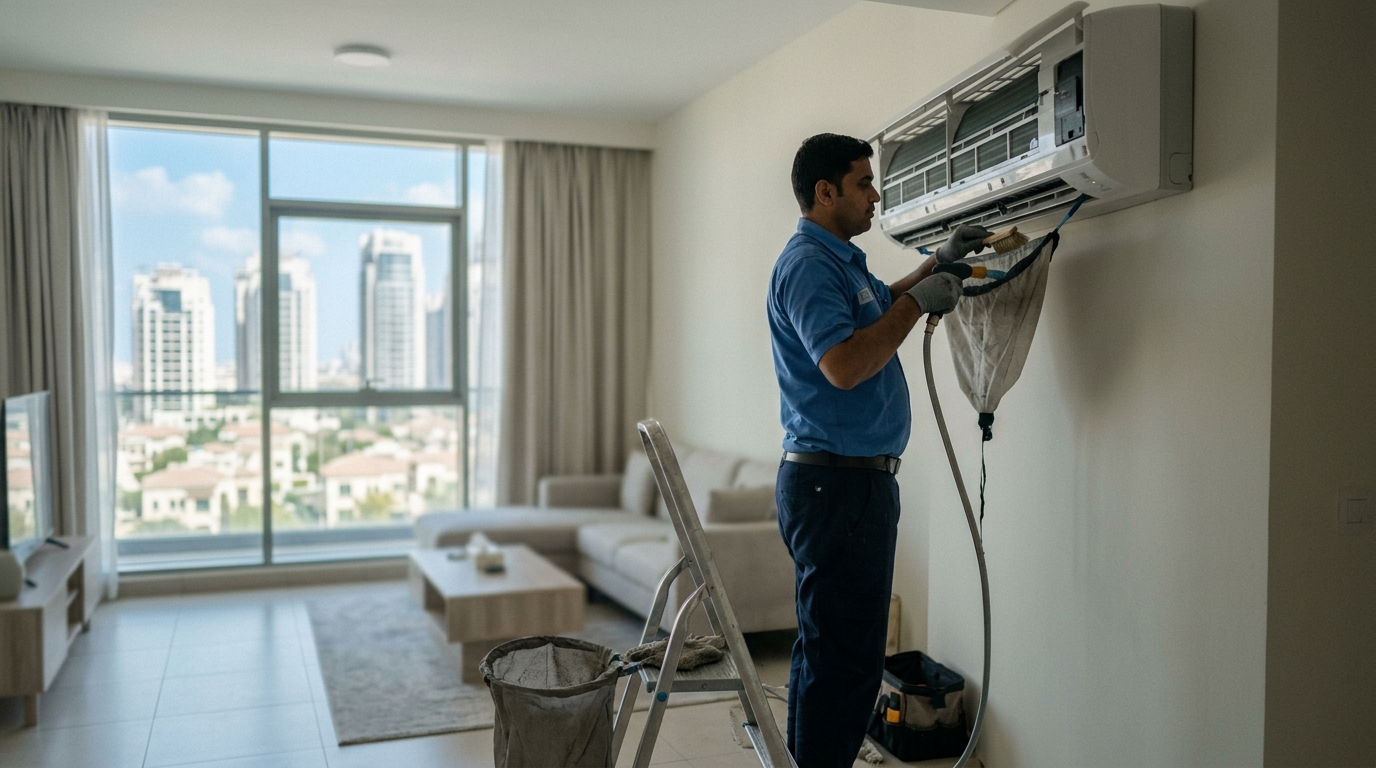
Dubai doesn’t really have an off-season for AC. Outdoor temperatures regularly sit above 40°C for months at a time, and even in the “cooler” winter stretch, most homes still run cooling daily. That means your system isn’t cycling on for a few hot afternoons a year – it’s running near-continuously for a large chunk of the calendar.
That kind of duty cycle exposes bad decisions fast. A unit sized for a milder climate, or installed without accounting for direct sun exposure on west-facing rooms, will struggle in ways that wouldn’t show up somewhere with a genuine winter. It also means the efficiency rating you pick isn’t a minor detail – a few percentage points of efficiency compound into a real difference on your DEWA bill when the system is running most of the day, most of the year.
The Main Types of AC Systems for Dubai Homes
Split AC Systems
A split system has one indoor unit and one outdoor compressor, connected by refrigerant lines. It’s the standard setup for individual rooms or apartments and remains the most common residential AC system installation in Dubai because it’s relatively quick to fit and doesn’t require ductwork.
Where it makes sense: apartments, single rooms, or additions where running ducts isn’t practical. Where it falls short: cooling more than a couple of rooms usually means multiple indoor units and multiple outdoor condensers, which starts to add up in both equipment cost and rooftop or balcony space.
Central AC System Installation
A central system uses one larger outdoor unit connected to ductwork that distributes cool air through vents across the home. This is the standard in most Dubai villas and larger apartments, and it’s what people usually mean when they ask about a full central AC system installation rather than room-by-room units.
The appeal is even cooling and a cleaner look – no indoor unit on every wall. The tradeoff is that ducted systems are more involved to install (and to service, since duct leaks or blockages are harder to spot than a problem with a single split unit), and retrofitting ductwork into a home that wasn’t built for it is a bigger job than most people expect.
Ducted Split Systems
This sits between the two. You get centralized ductwork and vents, similar to a central system, but powered by a split-style outdoor unit rather than a full central plant. It’s a common middle-ground choice for villas or townhouses that want central-style airflow without the scale (or cost) of a full central AC installation.
VRF/VRV Systems
For larger homes or properties with several distinct zones, variable refrigerant flow systems let you run multiple indoor units off a shared outdoor condenser, each zone controlled independently. It costs more upfront but gives you room-by-room temperature control without the space demands of several separate split systems.
Factors That Actually Determine the Right System for You
Room Size and Cooling Load

Cooling capacity is measured in tonnage or BTUs, and the number that matters isn’t just square footage – it’s a proper load calculation. Ceiling height, window size and orientation, insulation quality, and how many people typically use the space all change the math. An installer who quotes capacity off floor area alone, without asking about sun exposure or ceiling height, is skipping a step that shows up later as a unit that runs constantly but never quite catches up.
Energy Efficiency Rating
Look at the EER (Energy Efficiency Ratio) on the unit’s spec sheet, not just the sticker price. A less efficient unit is often cheaper to buy and more expensive to run – and because Dubai systems run so many hours per year, that gap between two similarly priced units can turn into a meaningfully different electricity bill within the first year or two.
Brand and Local Parts Availability
Daikin, Carrier, LG, and Gree are all widely serviced in the UAE, which matters more than it sounds – a great AC unit from a brand with thin local support means longer waits for parts if something breaks. Ask any installer you’re considering which brands they stock parts for locally before you commit.
Budget – But Not Just the Purchase Price
The unit price is only part of the AC system installation cost. Electrical work, ductwork (for central or ducted split systems), mounting brackets and drainage, and any structural modifications all factor in. A quote that looks unusually low compared to others is worth a second look – it may be excluding electrical work or using a smaller-capacity unit than your space actually needs.
What Drives AC System Installation Cost
There’s no single number that applies across the board, because the cost depends on several separate variables:
- System type: a single split unit costs meaningfully less than a central system covering an entire villa
- Property size and layout: more rooms, more zones, more ductwork
- Number of indoor units: each additional zone in a multi-split or VRF setup adds cost
- Ductwork condition: new ductwork costs more than reusing existing, functional ducts
- Electrical requirements: older properties sometimes need panel upgrades or new circuits to support a larger system
- Brand and efficiency tier: higher-EER units typically cost more upfront in exchange for lower running costs
Because of that spread, the only reliable way to know your actual AC system installation cost is a proper site assessment rather than a phone quote. Anyone willing to give you a firm number without seeing the property is either guessing or leaving room to adjust it later.
AC System Installation Requirements Before You Book
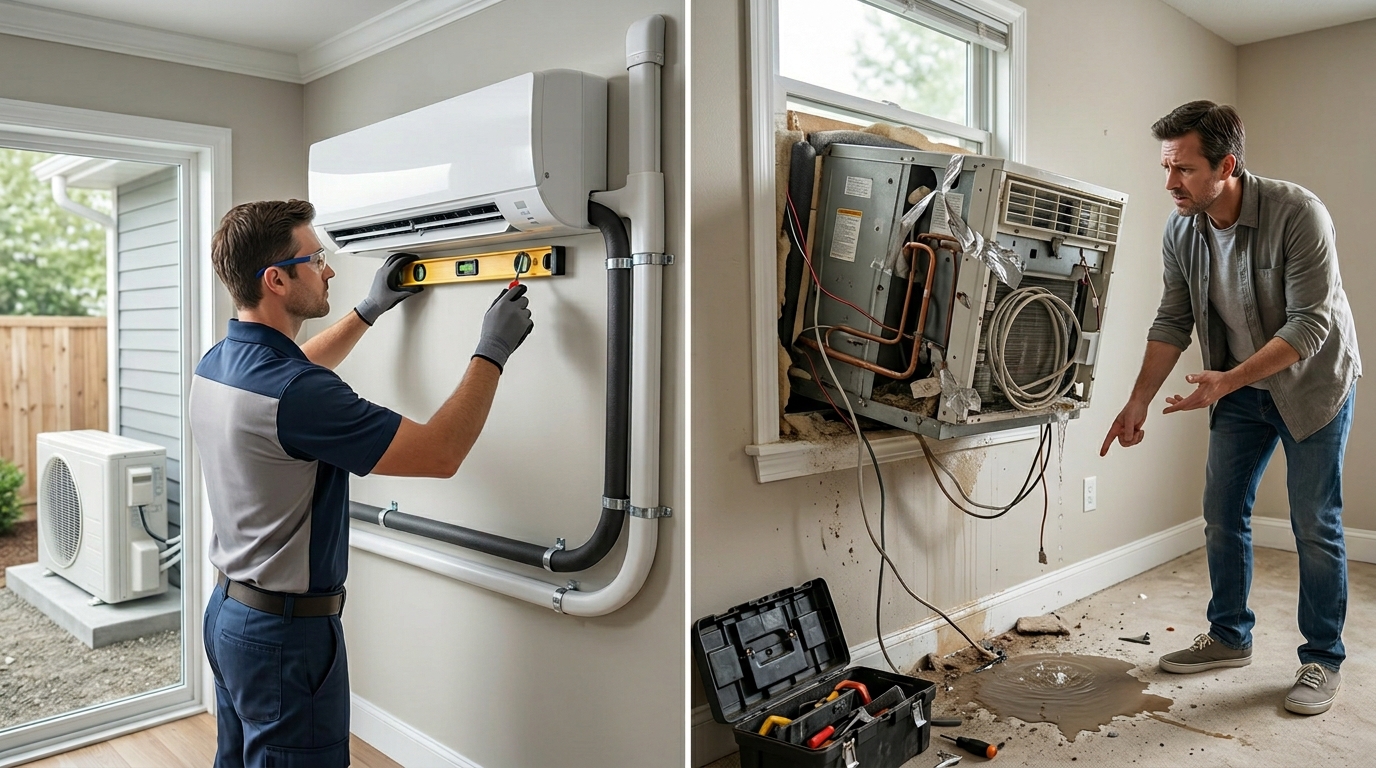
A few things worth confirming before a technician arrives so the job doesn’t stall halfway through:
Electrical capacity: Larger systems, especially central AC, need adequate circuit capacity. In older buildings this sometimes means an electrician needs to be involved before installation day, not during it.
Building or landlord approval: In apartment buildings, installing or modifying outdoor units – particularly anything affecting the building facade or shared plant rooms – usually needs sign-off from building management. Villas have more flexibility but exterior unit placement still matters for airflow and noise.
DEWA compliance: Electrical work tied to AC installation should follow DEWA’s safety standards, carried out by a licensed electrician. This isn’t optional paperwork – it’s what protects your warranty and your safety if something goes wrong down the line.
Access for outdoor units: Outdoor condensers need airflow clearance on all sides and shouldn’t be boxed into a tight, poorly ventilated space – a mistake that quietly reduces efficiency for the life of the system.
Drainage planning: Condensate needs somewhere to go. On upper floors or apartments, this needs to be routed properly rather than left to drip onto a balcony below.
A Straightforward New AC System Installation Guide: What the Process Looks Like
- Site assessment and load calculation: a technician measures the space, checks insulation, window exposure, and ceiling height, and calculates the cooling capacity you actually need.
- System and unit selection: Based on the assessment, you choose between split, central, ducted split, or VRF and settle on brand and efficiency tier.
- Electrical and structural check: confirming the property can support the system and flagging any panel or wiring work needed first.
- Installation: mounting indoor and outdoor units, running refrigerant lines and (where applicable) ductwork, wiring, and drainage.
- Refrigerant charging and testing: the system is charged to the manufacturer’s spec and tested under load, not just switched on and left.
- Final walkthrough: airflow, temperature, and noise levels are checked room by room before the job is signed off.
A rushed installation tends to skip straight from step 2 to step 4, and that’s usually where the problems that show up six months later get baked in.
Common Mistakes in Residential AC System Installation
Sizing by guesswork: “This room feels about the same as my last place” is not a load calculation.
Ignoring sun exposure: A west-facing room with floor-to-ceiling windows needs more capacity than an identically sized room facing north – a detail that’s easy to skip and expensive to correct later.
Boxing in the outdoor unit: Placing the condenser somewhere with poor airflow to save space cuts efficiency and shortens the unit’s working life.
Treating installation and maintenance as unrelated: A system that’s serviced regularly from day one runs more efficiently and breaks down less than one that’s installed and forgotten until it fails.
Choosing an installer by price alone: The cheapest quote sometimes reflects a smaller-capacity unit, skipped electrical work, or a technician who isn’t certified for the brand – none of which is obvious until later.
Central AC System Installation: A Few Extra Considerations

If you’re weighing a full central AC system installation for a villa, a couple of things matter beyond what applies to a single split unit. Ductwork design affects how evenly air reaches every room – poorly routed ducts mean some rooms run cold while others lag. Zoning is also worth asking about upfront: a basic central system cools the whole house to one setting, while a zoned system lets you set different areas independently, which is worth the extra cost for most multi-story villas where upstairs bedrooms and downstairs living areas have very different cooling needs.
Choosing Who Actually Installs It
The system on paper matters less than the quality of the installation itself. When comparing installers, it’s worth asking directly:
- Do they perform a proper load calculation on-site or quote based on square footage alone?
- Are their technicians certified for the specific brand you’re installing?
- What’s included in the quote – electrical work, ductwork, drainage – versus billed separately later?
- What warranty coverage applies to the installation itself, separate from the manufacturer’s unit warranty?
- Do they offer maintenance plans after installation, or is the relationship over once the unit is switched on?
That last point matters more than it seems. A system installed correctly and then maintained regularly will consistently outlast and outperform an identical unit that’s installed well but never serviced.
FAQs
What’s the difference between a split and central AC system installation?
A split system uses one indoor unit per room connected to an outdoor compressor, suited to apartments or single spaces. A central system uses ductwork to distribute cooling from one larger unit throughout the home, which is more common in villas.
How much does AC system installation cost in Dubai?
Cost depends on system type, property size, ductwork needs, and electrical work required, so it varies significantly between a single split unit and a full central system for a villa. A proper cost estimate requires an on-site assessment rather than a phone quote.
How long does a new AC system installation take?
A single split unit typically takes a few hours. A full central system installation, including ductwork, usually takes one to several days depending on property size and complexity.
What are the main AC system installation requirements for a Dubai home?
Adequate electrical capacity, DEWA-compliant wiring by a licensed electrician, proper drainage routing, sufficient outdoor unit clearance for airflow, and building or landlord approval where applicable.
Is central AC system installation worth it for an apartment?
Usually not, unless the building was designed for it. Central systems make the most sense for villas and larger properties where ductwork can be properly routed; apartments are typically better served by split or ducted split systems.
Can I reuse existing ductwork for a new central AC system installation?
Sometimes, if the ductwork is in good condition and sized correctly for the new system’s airflow requirements. A technician needs to inspect it first, since undersized or leaking ducts will undercut the new system’s efficiency regardless of how good the unit itself is.
How do I know what size AC system my home needs?
Through a load calculation that accounts for room dimensions, ceiling height, window exposure, insulation, and occupancy – not floor area alone. Ask any installer whether this is part of their process before you accept a quote.
Before You Book an Installation
The unit you choose matters, but the installation determines whether it actually performs as it’s supposed to. A correctly sized system, installed with proper electrical and drainage work and backed by a real warranty, will cost more to set up and less to run over the years than a rushed job built around the lowest quote.
If you’re planning a residential AC system installation in Dubai – whether that’s a single split unit or a full central system for a villa – start with a proper on-site assessment before comparing prices. It’s the only way to know what you’re actually being quoted for.