
Your energy bill arrives, and somehow it’s higher than last month, yet your home still feels warm. Sound familiar? The truth is, a struggling central air conditioning unit doesn’t always break down completely. Sometimes it just quietly loses efficiency over time, and you end up paying the price without realising why. In this article, we’ll walk through the most practical ways to get your system running the way it should without overcomplicating things.
What Makes a Central Air Conditioning Unit Inefficient?
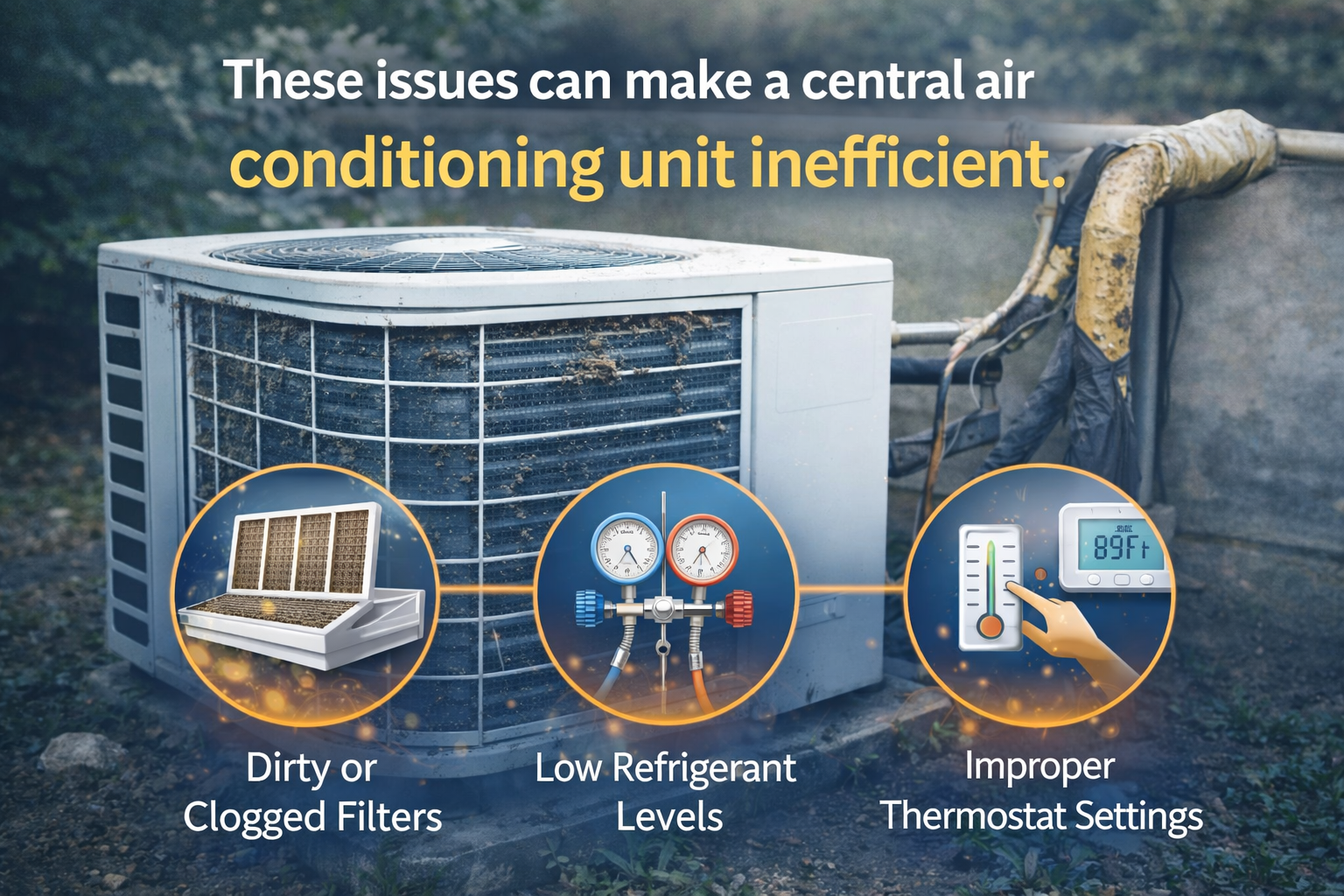
Most homeowners don’t notice a loss of efficiency until the bill spikes. By then, the central air conditioning unit has usually been struggling for a while.
Common causes of inefficiency:
- Dust and dirt buildup on coils and vents
- Blocked airflow around the unit
- Low refrigerant levels
- Worn-out parts
- An ageing system past its prime
Wrong sizing is also a big one. A unit too small runs constantly. One too-large short-cycle and never properly dehumidifies. Either way, efficiency suffers.
Importance of Regular Central Air Conditioner Maintenance
Regular central air conditioner maintenance is the single most effective thing you can do. Not exciting, but it works every time.
During a professional visit, a technician will:
- Check and top up refrigerant
- Clean evaporator and condenser coils
- Inspect electrical connections
- Clear the condensate drain line
- Test thermostat accuracy
Skipping this yearly is like ignoring your car’s oil change. Don’t wait for a breakdown schedule until summer hits. At AC Maintenance UAE, we always recommend a pre-summer service call, so your system isn’t under stress from day one.
How a Dirty Central Air Conditioner Filter Affects Efficiency
Think of your central air conditioner filter as the lungs of the system. When it’s clean, air flows freely. When it’s clogged, everything suffers. A dirty filter forces the blower motor to work harder to pull air through. This increases energy consumption, puts stress on internal components, and makes your home feel less cool even though the system runs more. Small problem, big impact. Checking and replacing your central air conditioner filter regularly is one of the easiest ways to protect performance without spending much at all.
How Often to Change Your Central Air Conditioner Filter
Most standard filters need replacing every 30 to 60 days. If you have pets, live in a dusty area, or run your system constantly, check it every 3 to 4 weeks. A quick visual check tells you everything. If it looks grey and clogged, swap it out. Don’t wait for the scheduled date. Staying on top of your central air conditioner filter is one of the simplest habits that pays off every month.
Cleaning Central Air Conditioner Components the Right Way
Dirty components make your system work harder than it should. Cleaning central air conditioner parts two to three times a year keeps performance where it needs to be.
What needs regular attention:
- Condenser coils: Rinse fins gently with a garden hose
- Evaporator coils: Dust here stops heat absorption
- Drain line: Blockages cause water damage and shutdowns
- Vents and grilles: Dust restricts airflow into every room
When to DIY vs Call a Professional for Cleaning
Do it yourself:
- Swapping filters
- Wiping vents and grilles
- Clearing outdoor unit debris
Call a professional:
- Internal coil cleaning
- Refrigerant line inspection
- Electrical component checks
Cleaning the central air conditioner’s internals incorrectly can cause serious damage. When in doubt, call someone qualified.
Upgrading to an Energy-Efficient Central Air Conditioner
At some point, maintenance alone isn’t enough. If your system is more than 12 to 15 years old and bills keep climbing, it might be time to switch to a more energy-efficient central air conditioner. Modern units use inverter technology that adjusts cooling output based on actual demand rather than switching on and off at full power. This alone cuts energy use significantly compared to older fixed-speed systems. The upfront cost of an energy-efficient central air conditioner can feel like a lot. But when you factor in monthly savings over several years, the numbers make sense fairly quickly.
What SEER Rating Should Your Unit Have?
SEER stands for Seasonal Energy Efficiency Ratio, a score that tells you how efficiently a unit cools relative to the energy it uses. A higher number means less electricity for the same job. For hot climates, a SEER rating of 16 or above is a solid benchmark. Units rated below 13 are outdated by today’s standards. If your system falls in that range, that gap is likely costing you money every single month.
Optimising Your Central Air Conditioning System for Peak Performance
Even a well-maintained central air conditioning system can underperform if the rest of your home isn’t working with it. Thermostat settings, insulation, and duct condition all play a role.
Quick wins to support your system:
- Use a programmable thermostat and raise the temperature slightly when no one’s home
- Seal gaps around doors and windows
- Add insulation to your attic
- Close blinds during peak sun hours
Small changes compound over a full summer season and take real load off your central air conditioning system.
How Duct Condition Impacts Your Central Air Conditioning System
Leaky ducts waste anywhere from 20 to 30 per cent of cooled air before it reaches a room. That’s a loss no amount of maintenance can fully fix.
Poorly sealed ducts in hot attic spaces are especially problematic because cool air loses temperature before it even arrives. Having your central air conditioning system ducts inspected and sealed is one of the highest-impact fixes for a unit that runs constantly but never quite cools properly.
Frequently Asked Questions
Q1) How often should I service my central air conditioning unit?
Once a year, ideally before summer. If it runs year-round, twice a year is better for consistent performance.
Q2) Why is my central air conditioning unit running but not cooling?
Start with the central air conditioner filter; it’s the easiest thing to check. Other causes include low refrigerant, blocked coils, or a failing compressor.
Q3) How long does a central air conditioning unit last?
With regular central air conditioner maintenance, most units last 12 to 15 years. Neglected systems often fail much sooner than that.
Q4) What SEER rating should I look for when buying?
16 and above is a solid benchmark for an energy-efficient central air conditioner in hot climates. Anything below 13 is considered outdated by today’s standards.
Q5) Does cleaning central air conditioner coils really make a difference?
Yes, dirty coils are one of the top causes of poor cooling performance. Cleaning central air conditioner coils even once a year has a measurable impact on efficiency.
Q6) How do I know if my central air conditioning system has duct leaks?
Uneven cooling across rooms, rising bills, and spaces that never reach the set temperature are all signs. A professional inspection of your central air conditioning system can confirm it.
Q7) How often should I change my central air conditioner filter?
Every 30 to 60 days for most homes. If you have pets or live in a dusty area, check your central air conditioner filter every 3 to 4 weeks instead.
Q8) Is it better to repair or replace an old central air conditioning unit?
If your system is over 12 years old and repair costs are adding up, replacing it with an energy-efficient central air conditioner usually makes more financial sense long term.
Q9) Can I improve efficiency without spending much money?
Absolutely. Simple habits like regular central air conditioner maintenance, timely filter changes, and sealing gaps around doors and windows go a long way without a big budget.
Q10) What temperature should I set my thermostat for efficiency?
Around 24 to 26 degrees Celsius is the sweet spot for most homes. Raising it slightly when no one is home reduces unnecessary runtime on your central air conditioning system.
Final Thoughts
Improving your central air conditioning unit’s efficiency doesn’t require one massive fix. It’s a combination of small, consistent habits, filter changes, annual servicing, proper cleaning, smart thermostat use, and duct care — that add up over time. Most people wait until something breaks. But a little attention throughout the year costs far less than an emergency repair or an early replacement. Stay consistent and act before small issues turn into bigger ones. At AC Maintenance UAE, we’ve seen firsthand how much proper care changes things not just in energy bills, but in how long a system actually lasts. Take care of your unit now, and it’ll take care of your comfort for years to come.