Your AC just died. It’s past midnight, it’s 44°C outside, and the air inside your apartment is already starting to feel thick. You’re not thinking about costs or warranties right now. You’re thinking about breathing. That moment, right there, is exactly what emergency AC repair exists for, and if you’ve lived in the UAE through even one real summer, you know it’s not an exaggeration.
Here’s what most people don’t realize, though. The breakdown didn’t happen suddenly. It was being built for weeks. And understanding that changes everything about how you handle it next time. This blog walks through what actually causes these failures, what they cost, and how to make smarter decisions when your cooling system picks the worst possible moment to give up.
What Actually Qualifies as an AC Emergency?
When your AC stops working on a mild day, waiting a few hours is fine. When it stops working in the UAE in July, you don’t have that option. Emergency AC repair is any situation where a failure makes the environment unsafe or genuinely unlivable, not just uncomfortable.
That said, people sometimes panic over issues that aren’t true emergencies, and sometimes brush off things that are. So here’s a practical way to think about it.
Call immediately if you’re dealing with any of these:
- The system is completely off and won’t restart
- Hot air is blowing continuously despite correct thermostat settings
- You hear grinding, banging, or hissing from the unit
- Water is dripping near wiring or electrical panels
- There’s a burning smell from the vents or the outdoor unit
- The breaker keeps tripping every time you switch the AC back on
Any single one of these in peak summer heat isn’t a “monitor it” situation. It’s a call-right-now situation.
Why Summer Is When Everything Falls Apart
There’s a reason AC units don’t fail in February. They fail in July, during the hottest week of the year, usually on a Friday evening. It feels like bad luck. It’s actually just physics.
During the UAE summer, a residential AC system runs almost constantly. We’re talking 16 to 18 hours a day in some homes. That kind of sustained load wears down components that were already showing quite signs of fatigue. The heat itself accelerates the degradation of electrical parts. So the system that seemed fine in April is genuinely struggling by June, and by August it’s running on borrowed time.
What the Compressor Goes Through
The compressor is doing the heaviest lifting in your entire system. It’s pressurizing refrigerant continuously, generating heat of its own while operating in outdoor temperatures that can exceed 45°C. When it finally gives out, you’re looking at the most expensive air conditioner repair scenario on the list. Compressor failure left unaddressed doesn’t just mean no cooling, either. It can trigger refrigerant leaks and damage surrounding components in a chain reaction that turns a single repair into a much bigger bill.
The Electrical Components Nobody Talks About
Capacitors and contactors don’t get much attention until they fail. They’re the components responsible for starting and keeping the motors running, and they degrade faster in extreme heat than almost anything else in the system. The good thing is that professional air conditioner repair for these parts is relatively quick and affordable, but only when it’s caught before the compressor takes the strain of compensating for them.
The Real Cost of Waiting
Here’s the thing about delayed repairs. People wait because they’re worried about cost. And then the cost gets higher because they waited. It’s one of those genuinely frustrating cycles that’s completely avoidable.
A refrigerant leak is a good example. In the early stages, you notice AC not cooling as well as it used to. Rooms take longer to reach temperature. The unit runs longer. Most people adjust the thermostat down and carry on. What’s actually happening is the evaporator coil is starting to ice over, and when that ice melts, it overflows the drain pan. Now you’ve got water damage on top of a refrigerant issue.
That’s not a horror story. That’s just what happens when small problems get ignored in systems running under extreme load. Catching AC not cooling issues early, before they compound, is genuinely one of the most cost-effective decisions you can make as a homeowner or tenant.
AC Repair Cost: Honest Numbers, No Vagueness
Nobody wants to be quoted a range so wide it tells them nothing. So here’s a realistic breakdown of what AC repair costs look like in the UAE for the most common emergency scenarios.
- Capacitor replacement: AED 200 to AED 450
- Contactor or relay replacement: AED 180 to AED 380
- Refrigerant recharge: AED 350 to AED 700, depending on refrigerant type
- Drain line clearing and pan cleaning: AED 150 to AED 300
- PCB or control board repair: AED 400 to AED 900
- Compressor replacement: AED 800 to AED 2,500 and up
- After-hours emergency callout fee: AED 100 to AED 200 on top of the repair
The truth about AC repair cost is that most common failures fall between AED 300 and AED 700 when they’re addressed quickly. The cases that push into the thousands are almost always situations where something small was ignored long enough to damage something bigger. Timing matters more than most people think.
Choosing an Emergency Service That Actually Shows Up
This part matters more than people realize. A lot of companies in the UAE advertise 24/7 emergency availability. Not all of them mean it.
When you’re calling at 1 am in August with no cooling and a household of people, you need someone who picks up, gives you a realistic arrival time, and then actually arrives in that window. Anything else isn’t an emergency service. It’s a regular service with a better tagline.
Before you confirm any emergency callout, ask these four things:
- What’s your actual response time to my area tonight, not your best-case estimate?
- Is the callout fee separate from or included in the repair quote?
- Do your technicians carry common parts in the van so the repair can happen in one visit?
- What warranty do you offer on the repair itself?
We, at AC Maintenance UAE, have always held the position that clients dealing with a midnight breakdown don’t need ambiguous pricing or vague arrival windows. They need someone to show up, fix the problem, and hand over a bill that matches what was agreed. That’s it. It sounds basic because it should be.
What Good Air Conditioner Repair Experts Actually Do On Arrival
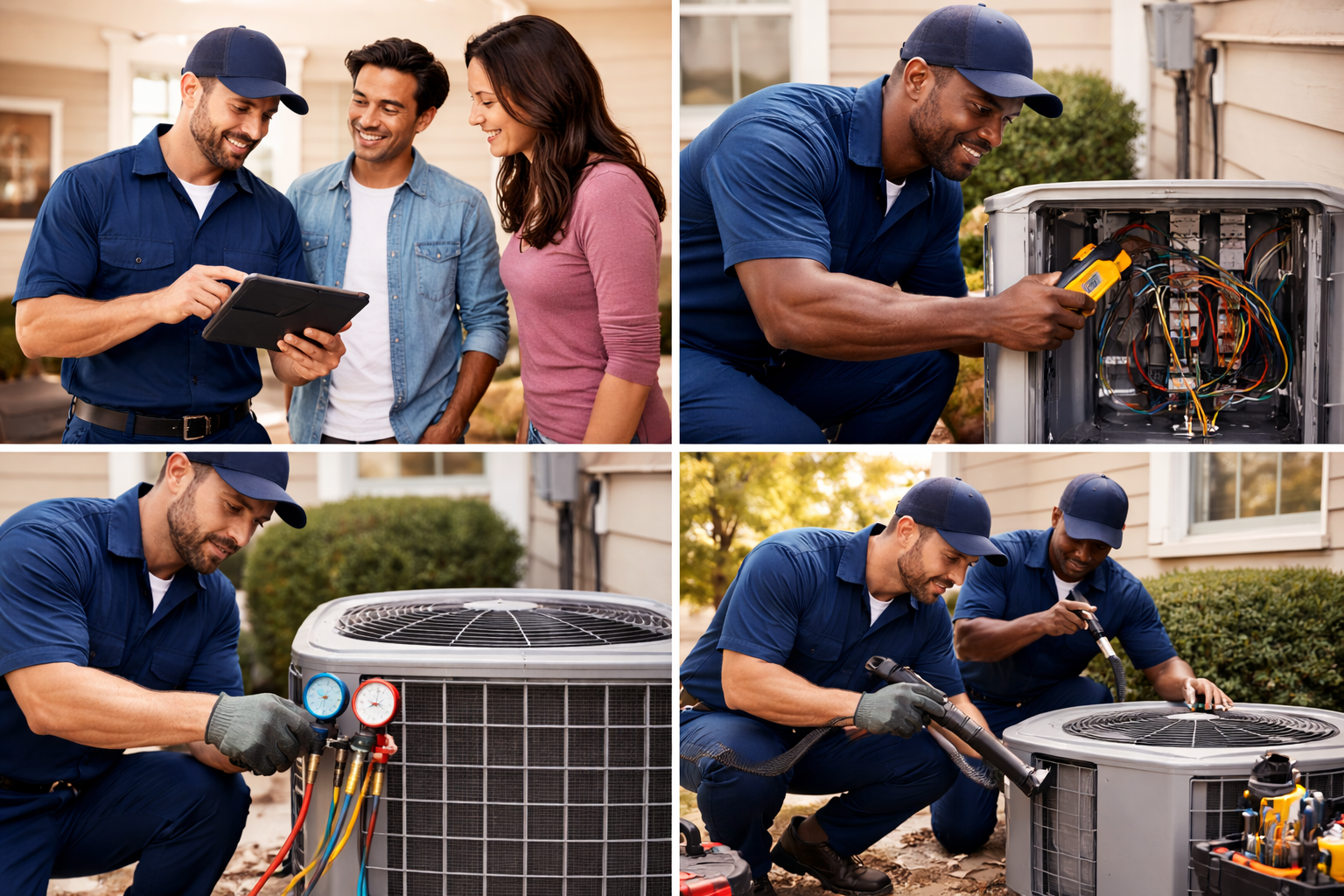
Knowing the proper sequence helps you spot whether a technician is doing the job right or cutting corners. Air conditioner repair experts worth their rate follow a specific diagnostic process before recommending or replacing anything.
Here’s the order it should happen in:
- Check the thermostat and power supply first; always rule out the simple stuff
- Inspect the air filter because a choked filter causes more breakdowns than most people expect
- Test capacitors, contactors, and fuses for electrical faults
- Measure refrigerant pressure to identify leaks or undercharge
- Inspect evaporator and condenser coils for ice, blockage, or fouling
- Run compressor diagnostics using pressure and electrical readings
- Check drainage for blockages or overflow risk
Any technician who skips straight to “you need a new compressor” without running through this process first is not following best practice. Real air conditioner repair experts diagnose the problem before they name the solution. That sequence protects you from unnecessary spending.
Preventing the Next Emergency
Honestly? Most emergency callouts are preventable. Not all of them, but most.
The breakdown that happens at 2 am on a Tuesday in August usually starts showing signs weeks earlier. Slightly weaker airflow. A room that takes a bit longer to cool. A sound that wasn’t there before. These aren’t random events. They’re a system telling you something is wearing out.
Practical habits that actually reduce breakdowns:
- Clean or replace filters every 4 to 6 weeks during summer, not every few months
- Book a pre-summer check in March or April, before the real heat arrives
- Keep the outdoor unit clear of dust buildup and wall obstructions
- Don’t set the thermostat below 20°C, as it forces the compressor to overwork
- If airflow feels weaker than usual, don’t ignore it for weeks
That last point about thermostat settings is genuinely underappreciated. Running a system at 17°C when it’s 45°C outside isn’t making you cooler faster. It’s just destroying the compressor faster. Setting it to 22°C or 23°C is kinder to the machine and your electricity bill.
Frequently Asked Questions
Q1) How fast should emergency AC repair happen during UAE summer?
In genuine UAE summer conditions, same-day service isn’t just preferable, it’s necessary. Indoor temperatures without cooling can reach dangerous levels within two to three hours in a closed apartment. Reputable emergency AC repair services aim for a one to three-hour arrival window, and anything beyond that in peak summer doesn’t really qualify as emergency response.
Q2) Is emergency AC repair always going to cost more than a regular callout?
There’s almost always an after-hours premium added to the standard AC repair cost, typically AED 100 to AED 200 on top of the repair itself. That said, the extra fee is almost always less than the additional damage caused by waiting until morning. Speed of response genuinely saves money in the long run.
Q3) What’s the most common reason AC units break down in summer?
Capacitor failure is responsible for roughly 30% of all summer emergency callouts in the UAE. The sustained heat accelerates wear on these components faster than almost anything else. Professional air conditioner repair for a failed capacitor is one of the quicker and more affordable fixes when caught before it causes secondary damage.
Q4) How do I know if my AC needs repair or full replacement?
The rule most air conditioner repair experts follow is: if the repair costs more than 50% of a new unit’s price, and the system is over 10 years old, replacement is usually the smarter financial decision. For newer systems with isolated faults, repair almost always wins. Don’t let anyone push you toward replacement without a proper diagnosis first.
Q5) AC not cooling properly, is it always urgent?
It depends on the degree and timing. AC not cooling to the set temperature in mild weather might wait a day. The same problem during a July heatwave in a home with young children or elderly residents is urgent. The underlying cause, whether it’s low refrigerant, a dirty coil, or a struggling capacitor, will only get worse under summer load. Don’t sit on it.
Q6) What should I do while waiting for the technician to arrive?
Switch the system completely off rather than leaving a malfunctioning unit running. This prevents additional damage in most fault scenarios. Close interior doors to hold any remaining cool air, and if indoor temperatures become genuinely dangerous, move vulnerable people to a cooler space until the AC unit repair is completed.
Q7) Does AC unit repair come with a warranty?
It should, and you should ask before the work begins. Labor warranties typically run 30 to 90 days, with parts warranties varying by component and brand. At AC Maintenance UAE, every repair includes a clear explanation of what’s covered and for how long, because finding out after the fact isn’t acceptable when you’re dealing with essential equipment.
Q8) How often should AC systems be serviced to avoid emergencies?
Twice a year is the standard for UAE residential systems, with the pre-summer service being the more important of the two. Regular servicing catches gradual wear on exactly the components that cause most emergency AC repair callouts. It’s the most straightforward way to reduce the chances of a 2 am breakdown in August.
Don’t Wait for the 2 am Wake-Up Call
Emergency AC repair in a UAE summer isn’t something you want to be googling for the first time when it’s already happening. Knowing the warning signs, having realistic AC repair cost expectations, and understanding what a proper repair process looks like puts you in a completely different position when something goes wrong.
Now that you know how to read your system before it fails, ready to stop treating AC breakdowns as inevitable? The difference between a quick capacitor fix and a full compressor replacement is almost always just how long you waited. Don’t give a small problem the time it needs to become a big one.