Cooling a busy Dubai office, restaurant, or warehouse isn’t like cooling a house. These spaces run longer hours, hold more people, and carry loads a small residential unit was never built for. Getting commercial ac installation right from the start protects comfort and your budget. A commercial project needs real planning first. What decides whether an installation works well: cooling load, system choice, airflow, energy use, and how it’s tested before handover.
What Should You Assess Before Commercial AC Installation in Dubai?
Before a commercial ac installation, look at the building itself. Floor area, headcount, window placement, kitchen or server room heat, insulation, and operating hours all shape how much cooling you actually need.
Skip the cooling load calculation and you’re guessing. A commercial HVAC installation Dubai project done properly starts with real numbers, not a rough estimate based on square footage.
Why Cooling Load Calculation Matters for Commercial Buildings

A restaurant kitchen throws off far more heat than a quiet office, even at the same size. Ignore that and you get uneven temperatures, higher bills, and a unit that never stops cycling.
How Do You Choose the Right Commercial AC System?
Split systems, ducted setups, packaged units, VRF, or central cooling: there’s no single right answer. A commercial AC system installation should match how the building gets used, not what’s popular.
Efficiency matters too. UAE rules set a minimum bar for commercial equipment, so an energy efficient commercial AC choice early on pays off in compliance and on the electricity bill.
Which AC System Fits Offices, Retail Spaces, and Large Premises?
Offices with several departments often suit VRF, since each zone runs independently. A single retail floor may work better with ducted, while a warehouse with high ceilings usually calls for packaged units. It depends on the building.
What Happens During Commercial AC Installation and Site Preparation?
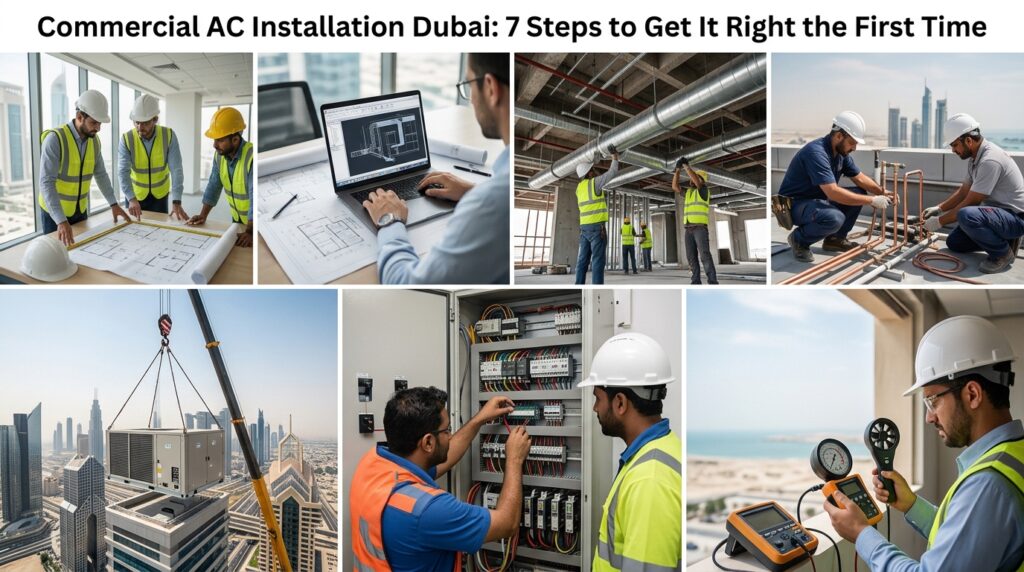
Once you’ve settled on a system, a commercial air conditioning installation moves into site prep: drawings, equipment placement, duct routes, refrigerant piping, and drainage, all worked out before a technician shows up.
Good AC installation services Dubai teams also sort out permits and coordinate electrical work with other trades, which matters more than people expect on a busy site. Our AC Installation Dubai page covers this in more detail.
What Should Be Checked Before Equipment Is Installed?
Materials, drawings, specs, mounting supports, tools, access routes: all need confirming first. Refrigerant piping, wiring, drainage, and ductwork should follow the approved design, not shortcuts, on any commercial air conditioning installation worth the name.
How Should Ductwork, Airflow, and Ventilation Be Planned?
A powerful unit doesn’t guarantee comfortable air. Part of any commercial AC installation Dubai project comes down to duct sizing and how air moves through the space.
Local guidance covers duct leakage, fresh air ventilation, pressure, and distribution for a reason. Airflow balancing deserves as much attention as picking the equipment, not a quick check at the end.
How Does Airflow Balancing Improve Commercial Cooling?
Balanced airflow removes hot spots and keeps rooms consistent. A meeting room used two hours a day behaves nothing like an open office running nine to six, and a retail floor with shifting foot traffic is its own case entirely.
What Makes a Commercial AC Installation Energy Efficient?
Energy efficiency isn’t just about buying an expensive unit. Correct sizing, insulation, and inverter technology matter just as much for a commercial ac installation that’s cheap to run.
When comparing AC installation cost Dubai quotes, weigh the upfront number against what it costs to run. The cheaper machine on paper isn’t always cheaper over five years.
How Can Businesses Reduce AC Running Costs After Installation?
An energy efficient commercial AC setup still needs upkeep. Oversized equipment wastes money long term, and regular filter and coil care, shutting off unused zones, and closed doors in cooled areas all add up. A sudden jump in energy use is usually the first sign something’s off.
What Should Testing and Commissioning Include?
Before handover, a commercial ac installation goes through full testing: refrigerant checks, electrical testing, drainage, and temperature performance across every zone.
Airflow and thermostat controls get checked too, and AC commissioning is the step that proves the system works as designed, not just that it switches on.
Many property owners set up a maintenance plan around now, and a company like AC Maintenance UAE can help map out that schedule, alongside an AC Maintenance Dubai plan and a final airflow balancing check to confirm even cooling before sign off.
What Should a Business Receive at Handover?

Expect operating instructions, equipment details, warranty paperwork, and maintenance notes at handover, not just a working unit. Control settings should be explained properly, and the installer should confirm the system matches the approved design before anyone signs off.
How Do You Avoid Common Commercial AC Installation Problems?
Most repair bills trace back to installation mistakes: poor sizing, equipment stuffed somewhere hard to reach, weak drainage slopes, or insulation that was never quite right.
A rushed commercial AC system installation tends to need more callouts over its lifetime, which is why the contractor matters more than the brand. A solid commercial HVAC installation Dubai team gets the fundamentals right the first time.
- Confirm cooling load calculations before ordering equipment to avoid a mismatch.
- Check drainage slope during installation, not after the unit is running.
- Coordinate electrical work early to avoid delays and last minute changes.
- Insulate ductwork properly to cut energy loss and stop condensation.
- Never skip commissioning, since it confirms the system performs as designed.
Commercial AC Installation Dubai FAQ
How long does commercial AC installation usually take in Dubai?
It depends on building size, system type, and how much ductwork and electrical work is involved. AC installation services Dubai teams usually finish standalone projects faster than ones folded into a larger fit out.
How much does commercial AC installation cost in Dubai?
AC installation cost Dubai pricing shifts with cooling capacity, equipment type, number of zones, ductwork, and site access. Complexity and chosen controls affect the final number.
Which AC system is best for a commercial building?
There isn’t one answer. It comes down to cooling demand, zoning, layout, operating hours, maintenance access, and future expansion plans.
Does commercial AC installation require professional cooling load calculations?
Yes. Professional numbers match the system to how the building behaves, cutting the risk of patchy cooling and wasted energy.
What should I check after commercial AC installation is completed?
Check cooling performance, airflow, drainage, thermostat response, and electrical safety. Listen for odd noises, and keep the commissioning records and warranty paperwork.
How often should a commercial AC system receive maintenance after installation?
It comes down to usage and occupancy. A system running hard all day needs more frequent checks than one in a lightly used room.
Conclusion
Seven stages, done right, separate a commercial ac installation that lasts from one that keeps causing headaches: proper assessment, the right system, careful site prep, planned airflow, real attention to energy use, thorough testing, and steering clear of repeat mistakes. Sizing and airflow matter as much as the unit itself, and testing proves it all works. If your Dubai property needs a professional assessment or an installation quote, get in touch from AC Maintenance UAE before you commit to any equipment.