You switch on the AC because the heat outside is already unbearable, and… nothing. The indoor unit might hum a little, but no cool air comes through, or the whole system just sits there silent. If this sounds familiar, you’re one of many people across the UAE searching for air conditioner repair right now.
An outdoor unit that quits on you can turn a comfortable home into a sauna within a couple of hours, and that’s rarely convenient timing. The good news? Most causes aren’t mysterious once you know where to look. Below, we’ll go through why outdoor units fail, what you can check yourself, and when it’s genuinely time to pick up the phone and call someone.
An outdoor air conditioning unit stops working when a key component, such as the capacitor, compressor, condenser fan motor, or electrical connections, fails or loses power. Some of this you can check on your own with basic air conditioner troubleshooting, but a lot of it really does need proper air conditioner repair.
What Does the Outdoor AC Unit Actually Do?
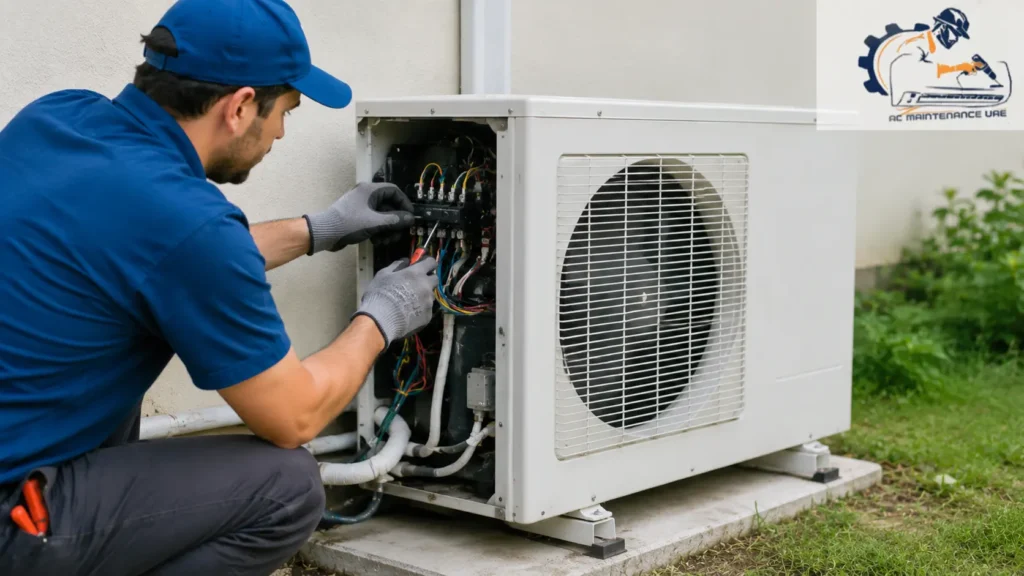
Think of the outdoor unit, or condenser, as the half of your AC system that does the heavy lifting outside your walls. It works alongside the indoor unit to pull heat out of your home and dump it outside. If it stops working, the indoor unit is basically useless, no matter how well it’s running.
A few parts inside the outdoor unit make this happen. The compressor pressurises refrigerant so it can absorb heat and let it go again later. The condenser coils are where that heat actually escapes. And the fan? It pushes air across those coils so the whole process can keep cycling. Lose one of these, and the entire system struggles.
Common Reasons Your Outdoor Unit Stops Working
These are the causes technicians run into most when a unit goes completely quiet.
Power Supply Problems
Sometimes it really is this simple: a tripped breaker, a blown fuse, or electrical connections that have come loose somewhere along the line.
- Check the main electrical panel for a tripped breaker first.
- Look near the outdoor disconnect box for a blown fuse.
- Take a look at any visible wiring for loose or corroded spots.
If you reset the breaker and it trips again almost immediately, don’t keep resetting it. That’s usually a sign of something bigger going on, and it’s time to call a technician.
Failed Capacitor
The capacitor is what gives your compressor and fan motor that initial kick of energy they need to get going. When there’s a capacitor failure, the unit might hum without actually starting, or it might do nothing at all.
A few signs point to a dying capacitor:
- Humming coming from the outdoor unit with no real action.
- Clicking sounds as the system tries and fails to start.
- The fan spinning slowly, or barely at all.
- The unit shutting off just seconds after it starts.
One important note: capacitors hold an electrical charge even after the power’s off, so this isn’t something to poke around with yourself.
AC Compressor Not Working
People often call the compressor the heart of the whole system, and for good reason. When your AC compressor not working properly, you’ll notice cooling drops off fast, or vanish altogether.
Keep an eye out for:
- Warm air coming through the vents instead of cool.
- Banging or knocking noises from the outdoor unit.
- The outdoor unit refusing to turn on at all.
- The breaker tripping over and over.
Compressors tend to fail from age, electrical faults, or years of skipped maintenance. And with how long the cooling season runs in the UAE, compressors here are working overtime compared to most other places.
Faulty AC Condenser Fan Motor
The AC condenser fan motor is responsible for pulling air through the unit to cool the refrigerant down. Once that motor stops, heat has nowhere to go, and the system often shuts itself down to avoid damage.
Signs to watch for include:
- Fan blades that aren’t spinning even though the unit has power.
- A burning smell drifting from the outdoor unit.
- The system overheating and cutting out after a short run.
- Grinding or squealing noises around the fan.
Dirty Condenser Coils
Dust and sand build up fast on outdoor coils here, more than in most climates. Once airflow gets blocked, the system has to work harder just to keep up, which leads to overheating and worse efficiency over time. A simple clean often fixes more than people expect.
Thermostat or Control Board Problems
Occasionally, the outdoor unit itself is perfectly fine; it’s just not getting the signal to switch on. A faulty thermostat or a control board glitch can break communication between the indoor and outdoor units, leaving you with an AC that just won’t respond.
Basic Air Conditioner Troubleshooting You Can Do
Before you call anyone, there are a few checks worth trying first. Here’s some basic air conditioner troubleshooting that’s safe to do yourself:
- Check the thermostat settings, and swap the batteries if it’s been a while.
- Reset the circuit breaker tied to your AC system.
- Give the outdoor unit a visual check for damage or blockages.
- Clear out leaves, sand, or debris sitting around the unit.
- Clean or replace air filters if they’re looking dirty.
- Listen for anything odd- clicking, humming, grinding- that wasn’t there before.
One safety note worth repeating: don’t open the electrical panel or touch internal wiring yourself. Outdoor units carry enough charge to genuinely hurt you.
Warning Signs You Shouldn’t Ignore
A few problems need urgent attention, not a wait-and-see approach:
- A burning smell from either unit.
- New buzzing or humming that wasn’t there before.
- Water leaking near the indoor unit.
- Ice or frost building up on the coils.
- The breaker tripping again and again.
- Airflow that feels weaker than usual.
Put these off for too long, and a small air conditioner repair job can turn into a full system replacement fairly quickly.
When Should You Call a Professional HVAC Repair Technician?
Some jobs just aren’t worth the risk of a DIY attempt. Call in a professional for HVAC repair if you’re dealing with:
- A capacitor that’s failed or clearly on its way out.
- Compressor trouble or strange compressor noises.
- What looks like a refrigerant leak.
- Any electrical issue beyond a simple breaker reset.
- A fan motor that needs replacing.
A licensed technician has the right tools and training to actually diagnose the problem, rather than guessing and hoping for the best.
How Regular Maintenance Prevents Outdoor Unit Failures
Routine maintenance is honestly the easiest way to dodge a surprise breakdown, especially given how hard AC units work through the UAE’s climate. A solid maintenance routine usually includes:
- Getting the system serviced by a professional once a year.
- Cleaning out the condenser coils.
- Swapping air filters on a regular schedule.
- Checking electrical connections for wear or corrosion.
- Making sure the fan motor is running smoothly.
Properties that stay on top of servicing tend to deal with fewer emergencies and lower repair bills overall.
Why Professional Air Conditioner Repair Saves Money
It’s tempting to put off a repair or try fixing it yourself, but that usually costs more down the line. Professional air conditioner repair gets you:
- An accurate diagnosis instead of a guess.
- The right replacement parts for your exact system.
- Safe handling of anything electrical.
- Your equipment warranty staying intact.
- Fewer repeat issues popping up later.
A trained technician can often catch a smaller problem before it snowballs into a full compressor or system replacement.
Frequently Asked Questions
1. Why is my outdoor AC unit not turning on?
Usually it comes down to a tripped breaker, a blown fuse, or loose electrical connections. A failed capacitor or compressor issue can cause this too.
2. What causes capacitor failure in an air conditioner?
Capacitors wear down over time from heat, age, and constant electrical cycling. Capacitor failure often shows up first as humming or a fan that won’t start.
3. Can I repair my outdoor AC unit myself?
Basic steps like resetting the breaker or clearing debris are fine to do yourself. Anything electrical or compressor-related should go to a licensed technician.
4. Why is my AC compressor not working?
An AC compressor not working usually points to age, electrical faults, or overheating. Years of light maintenance can also play a part.
5. What does an AC condenser fan motor do?
The AC condenser fan motor pulls air across the outdoor coils to help release heat. When it fails, the system can overheat and shut itself down.
6. How do I perform basic air conditioner troubleshooting?
Start with the thermostat, the breaker, and clearing any debris around the unit. This kind of air conditioner troubleshooting solves more minor issues than you’d think.
7. Can faulty electrical connections stop my AC?
Yes. Loose or corroded electrical connections can cut power to the outdoor unit with no other obvious warning.
8. How much does air conditioner repair usually cost?
It depends entirely on the issue, anywhere from a simple capacitor swap to a full compressor replacement. A technician can give you an accurate number after inspecting it.
Final Thoughts
Most outdoor unit failures trace back to a handful of usual suspects: electrical connections, capacitor failure, a struggling compressor, or a fan motor giving out. Catching these signs early can save you a much bigger bill later on.
A bit of basic air conditioner troubleshooting, like checking the breaker or clearing debris away from the unit, is a reasonable first step. But once you’re dealing with electrical parts, the compressor, or the fan motor, it’s worth bringing in someone qualified.
If your outdoor unit still won’t cooperate after trying the basics, get in touch with a licensed HVAC technician. A proper inspection now could save you from a far bigger, far pricier problem once summer really kicks in.