
Dubai heat does not give you a warning. One day, your AC is running fine, the next, it is struggling to keep a single room cool. And in a city where summer temperatures regularly cross 45 °C, that is not something you can put off until the weekend. Most people call for help too late, usually after the damage is already done and the repair bill has doubled.
This blog walks you through seven signs your AC is heading toward a serious problem. Spot them early, and you save yourself money, stress, and a very uncomfortable few days. The best AC repair Dubai residents rely on is the kind that fixes problems before they turn into emergencies.
Why Ignoring AC Problems in Dubai Always Costs More Later
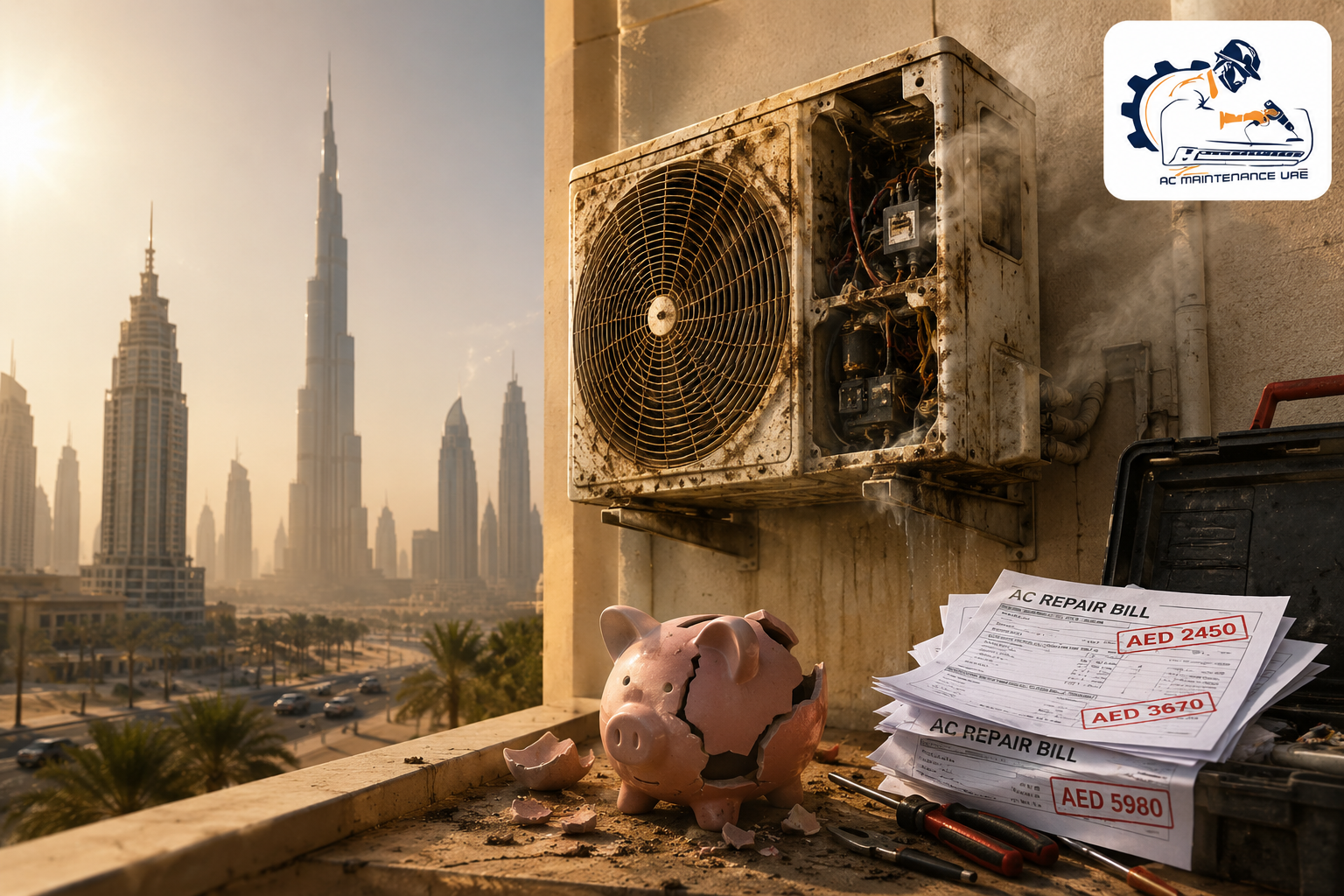
Dubai’s heat does something to AC systems that most people do not think about. Units here run almost nonstop for six to eight months a year. That is not normal wear. That is extreme wear.
A small fault under that kind of pressure does not stay small. A mildly blocked drain becomes a water-damaged ceiling. A slightly worn bearing becomes a failed motor. Every AC breakdown in Dubai that turns expensive started as something a technician could have sorted in under an hour.
Here Are the 7 Signs Your AC Is Crying for Help
Most people only notice something is wrong when the AC has already given up. But the truth is, your unit usually sends signals well before it stops working completely. These seven signs are what that looks like in real life. If any of them sound familiar, your AC is not fine, and waiting is only going to make the repair bigger.
Sign 1: Your AC Has Completely Stopped Turning On
When your AC is not turning on at all, the cause could be a tripped breaker, a dead capacitor, or an electrical fault inside the unit. None of these fix themselves. AC not turning on in Dubai summer needs the same-day attention, not a “let me check tomorrow” approach.
The risk is not just discomfort. Indoor temperatures in a closed Dubai apartment can become genuinely dangerous within hours of an AC failure during peak summer months.
Sign 2: Strange Sounds Are Coming From Your Unit
A working AC should be quiet enough that you forget it is running. If yours has started making noise you did not notice before, something inside has changed. An AC making a strange noise is usually the unit telling you a part is under stress or already failing.
Rattling, Banging, or Clicking Sounds
Loose components inside the unit are the usual cause here. Dubai’s dusty environment means debris gets pulled into the fan more often than in other climates, and worn bearings start clicking as they lose their grip. These sounds tend to get worse over time, not better. A loose part that is rattling today is a broken part that has damaged something else next month.
Hissing, Buzzing, or Whistling Sounds
Hissing almost always points to refrigerant escaping somewhere in the line. Buzzing usually means an electrical component, a relay, or a loose wire is not behaving the way it should. Whistling often means restricted airflow in the ducts. Each of these needs a different approach to fix properly. Treating one for the other just wastes time.
Sign 3: Water Is Dripping or Pooling Around Your Unit
AC water leaking indoors is one of those signs people wipe up and ignore, which is exactly the wrong response. Dubai’s humidity makes condensate drain lines block more frequently than in drier climates. When the drain is blocked, the water has to go somewhere, and that somewhere is usually your floor or ceiling.
Frozen evaporator coils cause this, too. When the ice melts, the water volume overwhelms the drain and overflows. Left for even a couple of days, you are looking at mould in the walls and water staining on the ceiling, both of which are far more expensive problems than the original AC fault.
Sign 4: Warm Air Is Blowing Through Your Vents
This one is frustrating because the unit sounds like it is working. You can hear it running. But the air coming through the vents is warm or barely cool. Low refrigerant and dirty condenser coils are the two main reasons this happens.
Both stop the system from doing the one thing it exists to do. This sign often gets ignored for weeks because the unit is technically still on. By the time someone calls the best AC repair Dubai company, the compressor has been running under serious strain for far too long.
Sign 5: A Strange Smell Is Coming From Your Vents
Smells coming through your vents are not a quirk to get used to. They are a signal. And some of them are more urgent than others.
Musty or Mouldy Smell
This means mould has taken hold somewhere in the drain pan or inside the ductwork. In a home with young children or elderly residents, mould spores circulating through the air supply are a real health concern, not a background inconvenience. Cleaning it properly means accessing parts of the system that are not easy to reach without the right tools.
Burning or Electrical Smell
Turn the unit off if you smell burning. Do not run it again until someone has checked the wiring. A burning smell usually points to a motor overheating or a wiring fault, and that is exactly the kind of situation that calls for emergency AC repair Dubai response rather than a scheduled appointment.
Sign 6: Your Electricity Bills Have Gone Up for No Reason
Nothing in your home has changed. No new appliances, no extra people, same usage. But the electricity bill is higher than it should be, and it has been creeping up for a couple of months.
Your AC is the most likely cause. When the unit has a fault, it pulls more power trying to reach the temperature you have set. Blocked filters force the fan to work harder. Refrigerant loss keeps the compressor running in longer cycles. These are the AC repair signs Dubai residents miss most often because the unit is still cooling, just doing it badly and expensively.
Sorting this early, before the compressor burns out, is one of the better ways to protect the long-term life of the unit. Calling the best AC repair Dubai company at this stage is almost always cheaper than waiting for the next sign on this list to show up.
Sign 7: The AC Keeps Switching On and Off by Itself
Short cycling is what happens when the unit starts, runs for a minute or two, then shuts off, then starts again. It sounds minor. It is not.
Every start-up cycle puts stress on the compressor. Short cycling can come from a thermostat fault, dirty condenser coils that cause the system to overheat and cut out, or a unit that was never the right size for the space it is cooling. Left alone, this pattern leads to early AC breakdown in Dubai and a compressor replacement that costs far more than the original fix would have.
What to Do When You Notice These Warning Signs
Not every AC repair sign Dubai homeowners notice will need an emergency call. Some things are worth checking yourself before picking up the phone. Others are not safe to leave to guesswork.
Checks You Can Handle Yourself
A few basic checks take five minutes and can sometimes save you a call:
- Pull out the air filter and check if it is clogged or grey with dust
- Reset the circuit breaker if the unit has stopped responding
- Check that the thermostat is set to cooling mode and the temperature is lower than the room temperature
- Clear any visible blockage around the outdoor drain pipe outlet
- Make sure nothing is blocking airflow around the outdoor unit
- Check that the remote has working batteries before assuming a bigger problem
When You Must Call a Professional
If those checks come back fine and the problem continues, it is time to stop and call someone. Refrigerant handling is not a DIY job. Electrical faults inside the unit are dangerous without the right training. Compressor issues need proper diagnostic equipment to even be identified correctly.
At AC Maintenance UAE, when our team handles these faults, we work through the diagnosis first before touching anything. Refrigerant issues get pressure-tested and recharged properly. Electrical faults get traced to the source rather than patched at the surface. That approach is what stops the same fault from coming back two weeks later.
How to Choose the Right AC Repair Company in Dubai
Picking the best AC repair Dubai company comes down to a few things that are easy to check before you commit to anyone. Any company working on electrical systems in Dubai needs a valid trade license and DEWA approval. That is not optional. Emergency AC repair Dubai availability matters equally. A company that only works regular hours is not useful when your unit stops at midnight in August.
Ask about pricing transparency before any work begins. Ask whether there is a warranty on parts and labour. A technician who has handled AC not turning on faults, refrigerant issues, and short cycling across hundreds of units in Dubai will diagnose faster and fix more accurately than someone still learning on the job.
FAQs
Q1) How do I know if my AC needs repair or a full replacement?
If the unit is under eight years old and the repair cost is less than half the price of a new one, repairing usually makes more sense. Older units with repeated faults are worth replacing.
Q2) Why is my AC not turning on even though there is power in the flat?
AC not turning on with power available usually means a tripped breaker, a dead capacitor, or a thermostat fault. A technician can identify the exact cause without guesswork.
Q3) Is the AC water leaking something I can ignore for a few days?
No. AC water leaking indoors can cause mould and ceiling damage within 48 hours in Dubai’s climate. It needs to be looked at quickly.
Q4) What usually causes the AC making strange noise out of nowhere?
AC making a strange noise suddenly points to a loose internal part, debris in the fan, or a bearing that is starting to fail. The longer it runs like that, the worse the damage.
Q5) When is an AC fault serious enough to count as an emergency?
A burning smell, a total loss of cooling during peak summer, or anything that looks like an electrical fault qualifies for emergency AC repair Dubai responds immediately.
Q6) Why has my electricity bill gone up when nothing at home has changed?
A unit with a fault draws more power to compensate. Dirty filters and low refrigerant are the most common hidden causes. This is one of the AC repair signs that Dubai homeowners tend to miss the longest.
Q7) How often should AC units be serviced in Dubai?
Twice a year at minimum, once before summer and once during. Dubai’s dust levels and operating hours make that frequency necessary to avoid unexpected failures.
Q8) Can I stop short cycling myself, or does it always need a technician?
You can check the thermostat settings and make sure the outdoor unit has clear airflow. If short cycling continues after that, a technician needs to check refrigerant levels and coil condition.
Don’t Wait for a Breakdown: Act on the Signs Today
Acting early saves money and adds years to your AC’s life. Every sign in this blog, whether it is noise, AC water leaking, warm air, or a bill that keeps climbing, is your system telling you something is wrong. Most people wait until the unit stops completely. By that point, a straightforward fix has turned into something far more costly.
The best AC repair Dubai residents rely on is not the one called during a crisis. It is the one called when the first sign appears. Small faults caught early stay small. Ignored faults grow into expensive ones. Your AC works harder in this climate than most people realise. Do not let a warning sign turn into a breakdown.