
You haven’t changed your habits. Same thermostat setting, same hours running, same household routine. And yet the DEWA bill keeps creeping up every month. If that sounds familiar, your air conditioner is probably working a lot harder than it used to, and it might already be time to think about AC repair Dubai residents can rely on before the problem gets more expensive.
Most AC problems don’t show up as a dramatic breakdown. They show up as a slightly higher number on a bill you barely glance at. By the time the unit actually stops cooling, it’s usually been running inefficiently for weeks or months already. This guide walks through the most common hidden causes behind rising AC-related electricity costs in Dubai homes and offices, what each one looks like before it turns into a full repair, and when it’s time to bring in a professional.
Why Your AC Bill Climbs Even When You Haven’t Changed Anything

Cooling systems don’t fail all at once. They lose efficiency in small stages, and each stage means the compressor runs longer to reach the same temperature. A unit that used to cool a room in fifteen minutes might now take twenty-five, and you’d never notice the difference sitting in the room. Your meter notices, though.
That’s really the pattern behind almost every cause on this list. Something reduces the system’s efficiency, the thermostat still eventually hits its target, and the only visible sign is a bill that’s higher than it should be. Once you know what to check, most of these are easy to catch early, and the rest are a good reason to book an AC repair service Dubai technicians can get to quickly.
Dirty or Blocked Air Filters
A clogged filter is probably the single most common reason an AC unit quietly starts costing more to run. When airflow gets restricted, the system has to push harder to move the same amount of cool air through the space, and that extra effort shows up directly in power draw.
Dubai’s dust levels make this worse than in most climates. Between sandstorms, construction dust, and general air quality, filters here collect debris faster than filters in cooler, cleaner regions. A filter that might last two or three months elsewhere can clog in a matter of weeks during peak summer.
How to Check It Yourself
Pull the filter out and hold it up to a light. If you can’t see light passing through it clearly, it’s due for a clean or a replacement. A visibly grey or dusty filter is already past the point where it’s costing you money every day it stays in place.
Low or Leaking Refrigerant
Refrigerant doesn’t get “used up” the way fuel does. If your system is low on refrigerant, that almost always means there’s a leak somewhere in the line, and the unit is running on less than it needs to cool properly.
The tricky part is that a low-refrigerant system usually keeps running, just less effectively. It never quite reaches the set temperature, so the compressor keeps cycling on, trying to close a gap it physically can’t close without a refill. That’s a lot of electricity spent chasing a target the system can’t hit, and a leak isn’t something to leave sitting.
Signs of a Refrigerant Leak
A hissing or bubbling sound near the unit, ice forming on the refrigerant lines, or air that feels warmer than it should even with the AC running constantly are all signs worth paying attention to. None of these fix themselves, and running the system in this state for weeks only adds to the bill while the underlying leak stays exactly where it was.
Dirty Condenser or Evaporator Coils
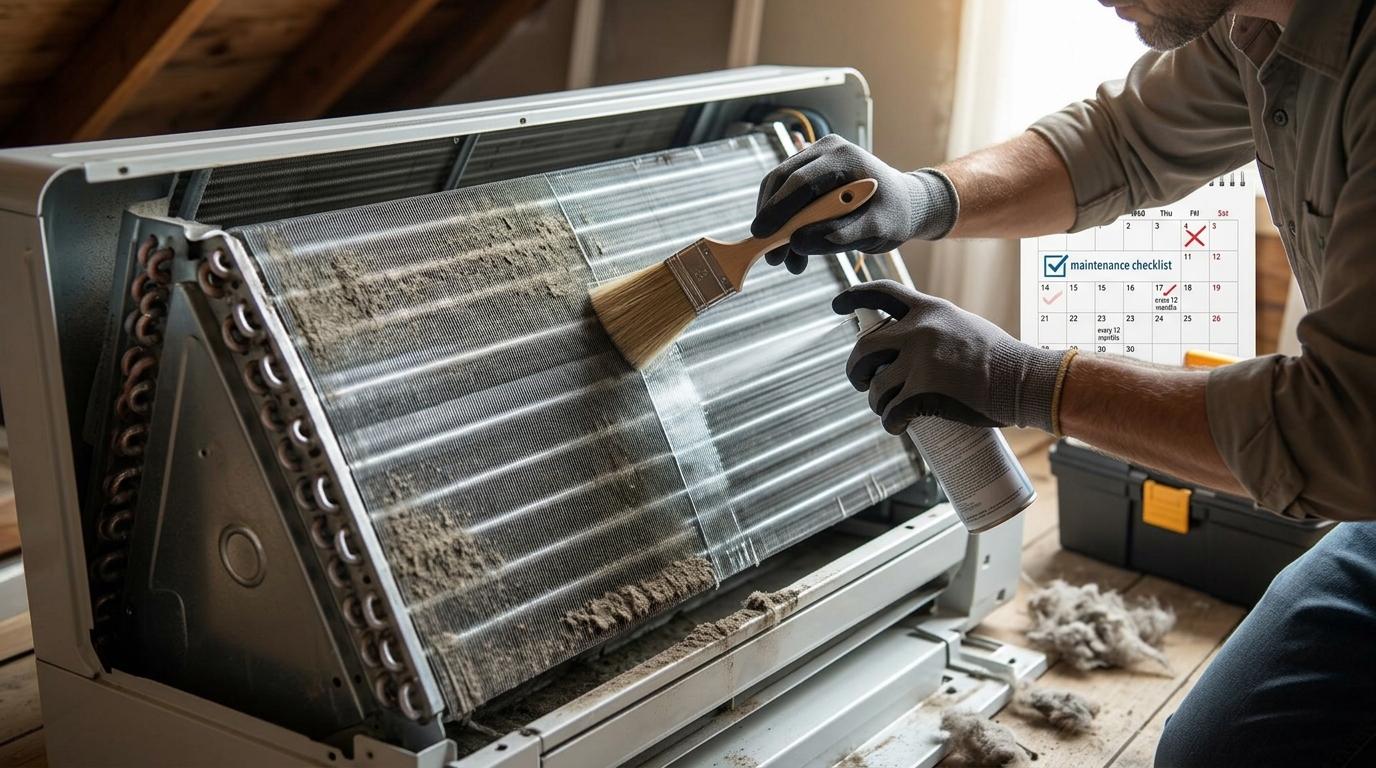
Coils are where the actual heat exchange happens, and when they’re coated in dust or grime, they can’t transfer heat the way they’re supposed to. Think of it like trying to feel a warm radiator through a thick blanket. The heat is still there, but it takes a lot longer to notice it.
A dirty coil forces the compressor to run longer to hit the same cooling result, which is exactly the kind of gradual inefficiency that adds up over a billing cycle without ever looking like a “problem” day to day.
Thermostat and Sensor Faults
A miscalibrated thermostat can cause the system to run longer than necessary without you ever adjusting a setting. Sometimes this looks like short-cycling, where the unit turns on and off more frequently than it should. Other times it looks like overcooling, where the system keeps running past the point where the room is actually comfortable because the sensor is reading the temperature wrong.
Either way, the thermostat is the one component telling the whole system when to stop, and if that instruction is wrong, everything downstream keeps working harder than it needs to.
Poor Duct Sealing or Insulation
If conditioned air is leaking out through gaps in the ductwork before it reaches the room, the system has no way of knowing that. It just keeps running because the room hasn’t reached the target temperature yet, not realizing that some of the cool air never made it there in the first place.
This is a common issue in older buildings or units that have gone a long time without an inspection. It’s also one of the harder problems to self-diagnose, since the leak is usually somewhere inside a wall or ceiling cavity rather than somewhere visible.
Oversized or Undersized AC Units
Sometimes the issue isn’t a fault at all. It’s a mismatch between the unit and the space it’s cooling. An undersized unit runs constantly trying to keep up with a room it was never built to handle. An oversized unit cools the space too quickly, shuts off, and then has to restart shortly after, which wastes energy differently.
If your AC has always felt like it runs longer than it should, even after filters, coils, and refrigerant have all checked out fine, sizing might be worth a second look from a technician who can measure the space properly.
When Hidden Problems Turn Into an Emergency

Most of the issues above build gradually, but a few can turn serious fast. A refrigerant leak that’s been ignored for months can eventually damage the compressor entirely. A duct or wiring fault can, in rare cases, become a safety issue rather than just a cost issue. If your unit stops cooling completely during peak summer heat, that’s not a wait-and-see situation.
This is where it helps to know a reliable emergency AC repair Dubai number ahead of time, rather than searching for one at midnight when the unit’s already dead. Dubai’s summer heat doesn’t leave much room for a slow response, and a same-day or 24 hour AC repair service can be the difference between a rough night and a genuinely dangerous one, especially in homes with young children, elderly residents, or anyone with health conditions sensitive to heat.
Finding the Best AC Repair Dubai Has to Offer
Not every hidden problem needs an emergency callout, but every one of them eventually needs a technician who can actually diagnose the cause instead of just replacing parts on a guess. When you’re comparing AC repair services in Dubai, a few things are worth checking before you commit:
- Whether they diagnose the actual cause (filter, coil, refrigerant, thermostat, ducting) rather than defaulting to a full unit replacement
- Whether they’re available on a 24 7 AC repair Dubai basis, since AC problems rarely wait for business hours in this climate
- Whether pricing is explained clearly before work starts
- Whether they can show experience with both residential and commercial systems
AC Maintenance UAE handles exactly this kind of diagnostic work, walking through each of the checkpoints above to find out where a system is actually losing efficiency, rather than guessing.
Skipped Maintenance Adding Up Over Time
None of the issues above tend to show up as a single dramatic event. They build gradually, and because each one only adds a small percentage to your running costs, it’s easy to write off a higher bill as “just the summer heat” rather than a specific, fixable cause underneath it.
The problem is that these issues compound. A dirty filter makes the coils work harder. Harder-working coils put more strain on the compressor. A strained compressor draws more power to do the same job it used to do more efficiently. What starts as one small maintenance gap can turn into several stacked inefficiencies within a single season and eventually into a repair that could have been a routine service instead.
Final Thoughts
A rising AC bill rarely has one single cause. It’s usually a combination of small, ordinary wear points, a dusty filter here, and a slightly low refrigerant charge there that quietly stack up over a season. None of them look urgent on their own, which is exactly why they tend to go unnoticed until the bill makes the problem impossible to ignore.
If the signs above sound like what you’ve been dealing with, a proper inspection can pinpoint the actual cause instead of leaving you to guess between filters, coils, or refrigerant. AC Maintenance UAE can walk through each of these checkpoints and tell you exactly where your system is losing efficiency before another billing cycle passes.
Frequently Asked Questions
Why is my AC increasing my electricity bill in Dubai?
Efficiency loss from dirt buildup, low refrigerant, or a mechanical fault forces the compressor to run longer to reach the same cooling result. The unit still works, it just works harder for the same outcome, and that extra runtime shows up on your bill.
How do I know if my AC filter is causing higher bills?
Pull the filter and check it against a light source. If dust is visibly blocking light from passing through, airflow is restricted enough to be costing you money, and it’s due for a clean or replacement.
Can a refrigerant leak really affect my electricity bill?
Yes. A system low on refrigerant can’t reach its set temperature efficiently, so it keeps cycling on trying to close a gap it physically can’t close, which uses significantly more power than a properly charged system.
When does a high AC bill mean I need emergency AC repair Dubai services?
If the unit has stopped cooling entirely, especially during peak summer heat, or you notice burning smells, sparking, or unusual electrical sounds, that’s an emergency rather than a routine fix, and it’s worth calling a 24 hour AC repair Dubai line rather than waiting.
What are signs my AC coils are dirty?
Weaker cooling than usual, longer run times to reach the set temperature, and ice buildup on the unit are the clearest signs that coils need cleaning.
Can a faulty thermostat increase energy use?
Yes. A miscalibrated thermostat can cause short-cycling or overcooling, where the system runs longer than actually needed because it’s reading the room’s temperature incorrectly.
Does an oversized or undersized AC unit waste electricity?
Both do, in different ways. An undersized unit runs constantly trying to keep up with a space it can’t fully cool, while an oversized unit cools too fast and restarts frequently, wasting energy each time it cycles back on.
How do I find the best AC repair company in Dubai for a hidden efficiency problem?
Look for a provider that diagnoses the actual cause, filter, coil, refrigerant, thermostat, or ducting, rather than jumping straight to a replacement, and one that can service both residential and commercial systems.
Is 24 7 AC repair Dubai coverage actually necessary?
In a climate where a broken AC can turn dangerous within hours, having access to round-the-clock AC repair service Dubai residents can call on is less of a luxury and more of a basic safety net, especially for households with children or elderly family members.
Can regular maintenance actually lower my electricity bill?
Yes. Catching filter, coil, and refrigerant issues early prevents the kind of gradual, compounding inefficiency that quietly drives bills up over a season, so consistent maintenance tends to pay for itself in lower running costs.
