The most neglected area of your entire cooling system is likely to be your central air conditioner filter, and that lack of attention is costing you. A dirty filter causes your ac to use more energy, increases your power bills, and filters dust and allergens directly into the air you breathe daily. This blog will take you step by step on how to ensure you have the correct filter, how to clean your filter, and ensure your system is running as it should be. The good news is that it is not as difficult as it is perceived by most people.
What Is a Central Air Conditioner Filter and Why Does It Matter
A central air conditioner filter is a device installed between your duct and the air conditioning unit, which prevents dust, pollen, pet dander, and other airborne particles from entering your system. Without it, your HVAC parts become covered in dust, airflow is reduced, and indoor air quality becomes significantly worse.
Imagine that your filter is quietly, unglamorous work every day. Once it becomes too dirty, it makes the downstream bear the cost. Your system is overloaded, your rooms are stuffy, and your electricity bill is creeping up without apparent cause. We are witnessing the same trend with constant homeowners being surprised to find out there was a single dirty filter that was responsible for weeks of ineffective cooling. It is among the simplest of home repairs, but it is one of the least considered.
Types of Central Air Conditioner Filters You Should Know
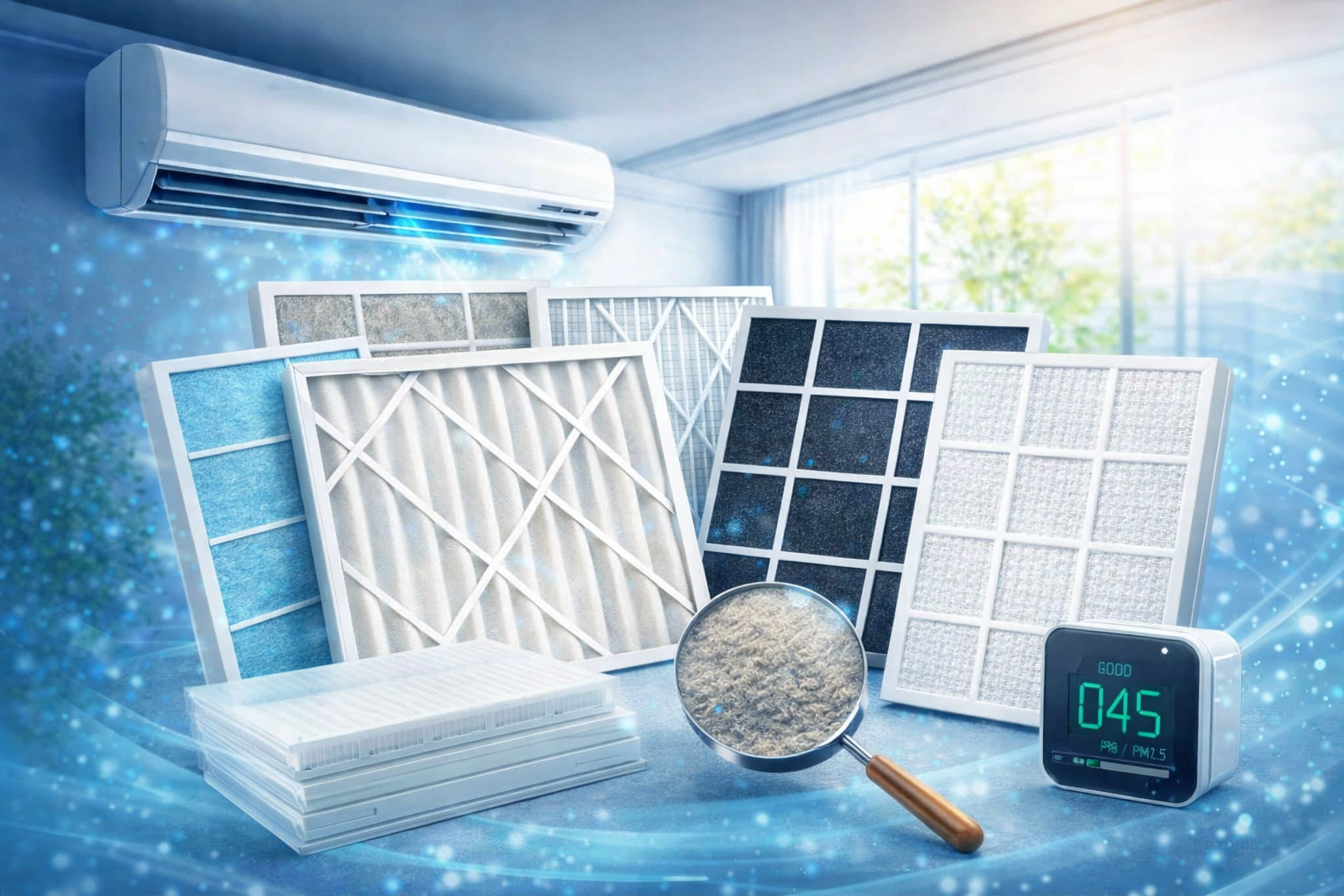
Not every filter is constructed the same. From simple fiberglass panels to more sophisticated HEPA units, the option you select directly influences the purity of the air that you breathe and the effort required of your system. Washable air conditioner filters and air conditioner dust filters are two of the most popular types, and for good reason.
The principal types of filters can be summarized as:
- Fiberglass filters: Inexpensive and simple, only large particles are captured.
- Pleated filters: Better filtration, captures smaller particles such as pollen and mould spores.
- Washable air conditioner filters -Reusable and economical in the long run, as they need frequent cleaning.
- HEPA filters: the highest level of filtration is not necessarily compatible with typical HVAC systems.
- Air conditioner dust filters – Designed to work under heavy dust conditions.
All types have their own niche, based on what you need in your home, your budget, and your air quality.
Washable vs Disposable Air Conditioner Filters
Washable air conditioner filters are reusable filters that can be rinsed, dried, and reinstalled; no repeat purchases are required. Disposable filters, however, are disposed of after 30 to 90 days according to the conditions in households.
Washable filters are more expensive to buy initially but are economical in the long run because they last three or five years when well-maintained. Disposables cost less to initiate, and replacement costs add up easily; they produce a lot of waste. When it comes to filtration, disposables have a wide range of options based on their MERV rating, whereas washable ones are typically in the middle range. When you are the sort of person who keeps up with the maintenance, washable air conditioner filters are very economical. In case you forget, disposables are less judgmental as you just replace them and proceed.
How to Choose the Right Central Air Conditioner Filter
Three factors contribute to picking the right size, the right MERV rating, and the right type of central air conditioner filter to use in your home. Get either of these incorrect, and you are either stifling air or allowing pollutants to pass by.
The following are what to consider before purchasing:
- Home environment: Pets, smokers, or allergy victims require a higher MERV rating.
- System compatibility: Not every HVAC can work effectively with thick or dense filters.
- Budget: Compare initial cost and replacement rate.
- Local air quality: Dusty climates, such as the UAE, require filters to be changed frequently.
How to Find the Correct AC Filter Size for Your System
AC filter sizes are printed directly on the frame of your existing filter. You will see three numbers like 20x25x1 representing length, width, and thickness in inches. When the label has come off, use a tape measure to measure the filter slot.
Miscalculating the size of ac filters is not as rare as you would imagine. A small filter has holes through which air not filtered is allowed to pass. Too big and it just won’t fit. It is always better to check twice before placing an order, particularly when you are making a large purchase.
Best Air Conditioner Filter for Allergies and Dust Sensitivity
MERV ratings are important in case a person in your house is allergic, has asthma, or is sensitive to dust. An air filter for allergies should be rated at least MERV 11, which captures pet dander, dust mites, and mold spores effectively.
- MERV 8: Good general use, dust, and pollen.
- MERV 11: good in homes that have pets or mild allergies.
- MERV 13: The best air filter to prevent allergies, bacteria, and fine particles.
One thing to know is that a higher MERV is not necessarily good for your system. Certain older units of HVAC have difficulty with airflow limitation at MERV 13. Switching should be done by checking your system manual or by asking a technician.
How to Clean Your Central Air Conditioner Filter Step by Step
There is nothing complex about central air conditioner filter cleaning, though, and the worst thing about it is that neglecting to follow the steps may do more harm than a dirty filter ever could. The following is all you need to know to do it right.
Items you will require:
- Soft brush or vacuum.
- Mild dish soap
- Lukewarm water
- Clean towel
- Good airflow drying space.
When Should You Clean Your Central AC Filter
Central AC filter cleaning (that is, filter cleaning) should be done every 3 to 4 weeks in dusty conditions, which, again, in the UAE means almost always. Good indicators that your filter needs to be taken care of include: not enough air flowing through vents, observable grey dust accumulation on the filter surface, and a musty odor emitted by the AC.
Waiting until your system is visibly struggling is not a good thing to do. At this stage, dust has probably already settled on the evaporator coil, which is far more difficult and expensive to repair than a mere filter rinse.
Step-by-Step Guide: How to Clean a Central AC Filter at Home
Follow these steps for how to clean the central AC filter safely and effectively:
- Before taking out the filter, switch off your AC unit.
- Slide the filter out, shake it not indoors, and dust it.
- Use the soft brush attachment to clean the vacuum on both sides to collect loose debris.
- Wash under lukewarm water flow, the water in the opposite direction of the usual airflow.
- Use a small amount of dish soap in case the filter contains grease or a lot of build-up.
- Run under water until all the water is clear.
- Air dry thoroughly for 2 to 3 hours, no less.
- Install when completely dry. Cleaning the filter when wet results in the growth of molds within your unit.
The latter step is something that surprises many. It would seem safe to reinstall a slightly wet filter, but in a dark, cool AC unit, moisture and mold spread quickly.
Common Mistakes to Avoid When Cleaning Your AC Filter
Even individuals who clean filters regularly commit mistakes that are preventable. These are the most common ones that we encounter:
- Re-inserting a damp filter results in mould and stale air.
- Incorporating rough chemicals, bleach, and strong cleaners destroys filter fibres and lowers efficiency.
- Ignorance of wrong ac filter sizes. A loose air conditioner dust filter allows air to pass through the entire system without passing through the filter.
- Delay of cleanings. In dusty climates, it is an absolute minimum, not a recommendation, to clean monthly.
- Leaving out checking tears or damage, a physically damaged filter must be replaced, not cleaned.
- Omission of the drying step. Repeat of this mistake is the most frequent and the most injudicious.
Cleaning a low-quality air conditioner dust filter over and over again is something people hardly ever give a second thought to, but the fact is that it makes its fibers decay at a faster rate than anticipated. Replacement just makes sense at some point as opposed to another rinse.
Frequently Asked Questions
Q1: How often should I clean my central air conditioner filter?
In most homes, every 30 days is a solid habit. In dusty regions like the UAE, checking every 2 to 3 weeks makes more sense. If you have pets or allergy sufferers at home, clean it even more frequently to keep air quality consistent.
Q2: Can I wash a central air conditioner filter with water?
Yes, but only if it is one of the washable air conditioner filters designed for rinsing. Disposable filters collapse and lose their filtration structure when wet. Always check the filter label or packaging before running it under water.
Q3: What happens if I use the wrong AC filter size?
Gaps around an undersized filter allow unfiltered air to pass straight through your system. This means dust, pollen, and debris reach your evaporator coil directly, leading to buildup, reduced efficiency, and potential mechanical issues over time.
Q4: What is the best MERV rating for an air filter for allergies?
MERV 11 is the most practical starting point; it captures pet dander, dust mites, and mold spores without heavily restricting airflow. MERV 13 offers stronger filtration but may not be compatible with all residential HVAC systems.
Q5: How do I know when my central AC filter needs replacing instead of cleaning?
If the filter has visible tears, bent frames, or no longer holds its shape after drying, it needs to be replaced. Central AC filter cleaning works well for minor to moderate buildup, but a physically damaged filter cannot be restored through washing.
Q6: Does a dirty air conditioner dust filter really affect energy bills?
Absolutely. A clogged air conditioner dust filter forces your system to pull harder to circulate air, which increases energy consumption noticeably. Most homeowners see a measurable drop in electricity costs simply by keeping their filter clean.
Q7: Are washable air conditioner filters worth it?
For most households, yes. Washable air conditioner filters cost more upfront but last several years with proper care. The savings on replacements add up quickly, and they generate far less waste than disposable options over time.
Q8: How long should I wait before reinstalling a cleaned AC filter?
Wait until it is completely and fully dry, typically 2 to 3 hours minimum in a well-ventilated space. Rushing this and reinstalling a damp filter is one of the fastest ways to introduce mold into your AC system.
Final Verdict: Choosing and Cleaning Your Central Air Conditioner Filter
This is the reality that makes your own home-care so important in terms of return-on-effort, as the maintenance of your own central air conditioner filter. A half hour of cleaning your central air conditioner filter at least once or twice a few weeks spares you expensive repairs, poor indoor air, and skyrocketing electricity bills. Select the appropriate filter that fits your household requirements, select appropriate ac filter sizes to fit your system, and remain consistent before accumulation becomes an actual issue. In case there is an allergy issue, then it is better to have an air filter that is allergy-rated and with a minimum of MERV 11 or above, and more frequently than what the average household would check.
Our team, AC Maintenance UAE, has clients all over the UAE who have encountered unnecessary AC issues, and in the vast majority of cases, improved practices in filter use would have averted them altogether. You are already in the lead of the majority now that you understand how to select and keep your filter.