Your AC stopped cooling on the hottest afternoon of the year. The technician shows up, pokes around for twenty minutes, and says those four words you were dreading: “It’s your compressor.” Now what?
That moment hits differently when you’re staring at a potentially massive bill, and you genuinely don’t know whether to repair, replace, or just cry a little. AC compressor repair is one of those decisions that feels impossible without the right information. This post breaks it all down: the warning signs, the real costs, and how to figure out what actually makes sense for your situation. No fluff.
What Does an AC Compressor Do and Why Does It Matter?
Before jumping into repair vs. replace, it helps to understand what you’re actually dealing with. Most people know the compressor is “important” but not exactly why. Once you get it, the repair decision starts making a lot more sense.
The compressor is essentially the heart of your entire cooling system. It pressurizes the refrigerant and pushes it through the system so heat can be pulled out of your space and cool air can come in. Without a functioning compressor, nothing else in your AC matters; it’s that central. Think of it like the engine in a car. Every other component depends on it working correctly. When it starts failing, the whole system starts underperforming, and you’ll feel it almost immediately in how your space feels.
Common Signs of AC Compressor Failure
Most compressor problems don’t announce themselves all at once. They creep in slowly, a weird sound here, slightly warmer air there. The tricky part is that these symptoms can look like other issues, too. Here’s how to tell when the compressor itself is likely the problem.
Is Your AC Not Cooling Properly?
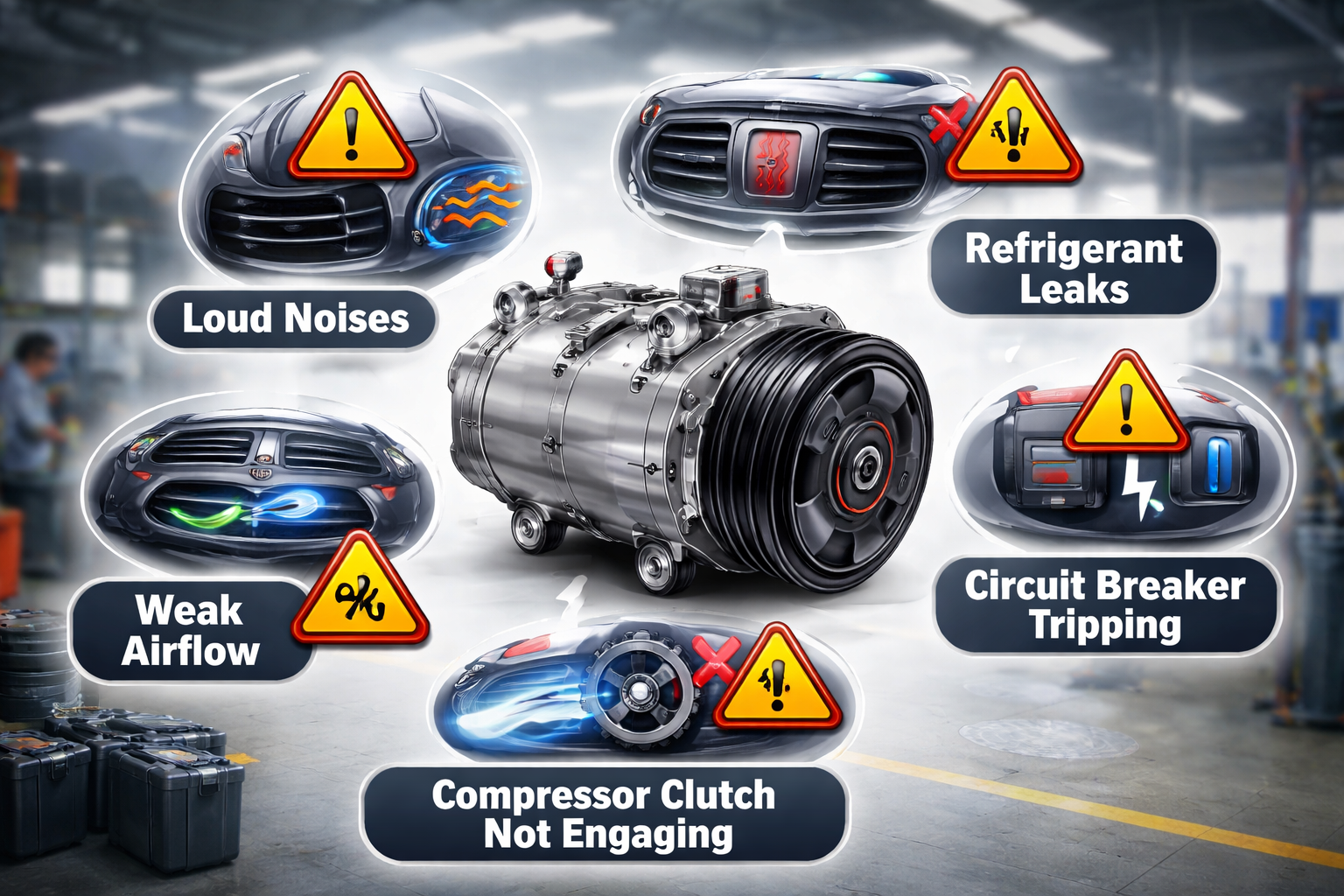
This is usually the first thing people notice: the AC is running, the fan is blowing, but the air just isn’t cold anymore. It’s easy to brush off at first, especially when temperatures fluctuate. But persistent warm airflow is your system waving a red flag. Weak, warm, or inconsistent airflow is one of the earliest signs of ac compressor failure. If your unit is running but the air coming through isn’t cold, the compressor may not be building proper pressure.
This symptom ac system is not cooling despite running, which is frustrating because it’s easy to assume it’s just a refrigerant issue. Sometimes it is. But if a recharge doesn’t fix it, the compressor is often the next suspect. Don’t ignore this one.
Strange AC Compressor Noise You Shouldn’t Ignore
Sound is one of the most honest things your AC will tell you. A healthy system runs with a consistent, fairly quiet hum. Anything that breaks from that pattern, grinding, rattling, or hard clicking, is worth taking seriously, even if the unit still seems to be working.
Different ac compressor noise types each point to different problems:
- Grinding or screeching is usually an internal mechanical failure, or worn bearings
- Rattling or clanking loose components inside the compressor unit
- Clicking on the startup electrical relay or capacitor issues
- Constant humming without starting the compressor is trying, but can’t turn over
Any new or unusual ac compressor noise should be looked at immediately. Waiting usually makes it worse and more expensive.
When AC Compressor Repair Is Worth It
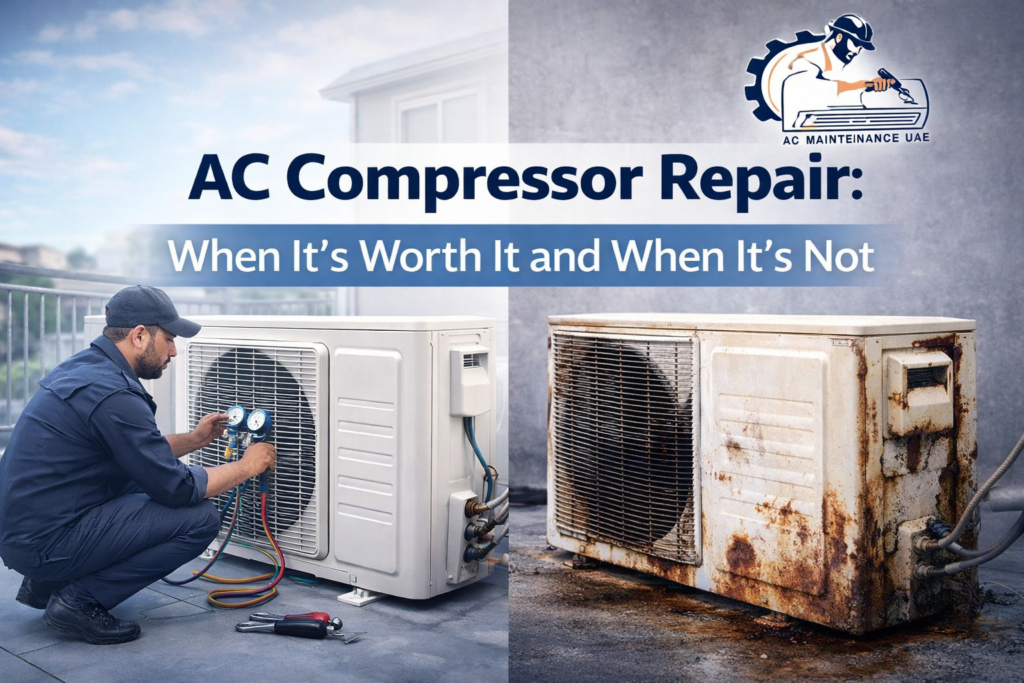
Not every compressor diagnosis ends with a huge bill, and that’s worth saying upfront. There are real situations where repair is the right move, both financially and practically. The key is knowing what those situations actually look like. Repair makes sense when the issue is minor, the system is relatively new, and the cost doesn’t exceed half the value of your unit.
Here’s the truth: not every compressor problem needs a full replacement. Sometimes it’s a small electrical fault, a capacitor swap, or a refrigerant-related pressure issue that mimics bigger problems. In those cases, ac compressor repair is absolutely the right call. If your system is under five years old and the repair cost is reasonable, fixing it is the financially smart move. A newer system has years of reliable life left, and replacing the whole thing prematurely is just wasteful.
How Age and Warranty Affect Your Repair Decision
These two factors alone can completely flip the decision. A system that’s two years old with an active warranty is in a very different position than a decade-old unit running on borrowed time. Always check both before agreeing to anything.
A unit under warranty changes everything. Before you spend a dollar on repairs, check your documentation. Many manufacturers cover compressor failures for five to ten years, and some extended warranties cover labor too. At AC Maintenance UAE, we always advise clients to verify warranty status before authorizing any major repair work. If you’re within the warranty window, ac compressor repair costs could be significantly reduced or even covered entirely. That’s a completely different financial picture than paying out of pocket on an older system.
When AC Compressor Repair Is NOT Worth It
This is where the honest conversation gets harder. Nobody wants to hear that their system is done, but sometimes holding on costs more than letting go. Here are the situations where repair genuinely stops making sense. If your system is over ten years old, out of warranty, and the repair cost is approaching or exceeding 50% of a new unit’s price, walk away. This is where people tend to make emotional decisions instead of practical ones. It’s understandable. Nobody wants to spend money on a new system when the old one might be fixable. But holding onto a dying compressor can cost you more in repeated repairs and inflated energy bills than a replacement would.
A few clear signals that repair isn’t worth it:
- The unit uses R-22 refrigerant (phased out, expensive to source)
- You’ve already repaired the compressor once in the last two years
- Multiple components are failing at the same time
- Energy bills have been climbing with no clear explanation
At some point, you’re not repairing an AC, you’re funding its slow funeral.
AC Compressor Repair vs Replacement: Full Cost Breakdown
Numbers make this decision a lot easier. Once you see what different repair scenarios actually cost compared to full replacement, the right path usually becomes clearer pretty quickly. Here’s a straightforward look at where your situation might fall. Repair costs range from AED 300 to AED 2,500+, depending on the issue; full replacement can run AED 3,000 to AED 8,000 or more for residential systems.
The 50% Rule is the most practical guide here: if the air conditioner compressor cost for repair exceeds 50% of what a new unit costs, replace it. This rule holds up in most real-world scenarios and keeps you from throwing good money after bad. AC compressor replacement makes the most financial sense when you’re dealing with an older system where future repairs are almost guaranteed. A new system also uses current refrigerants, runs more efficiently, and typically comes with a fresh warranty.
How to Change an AC Compressor: What the Process Involves
If you’ve been wondering what actually happens when a technician replaces a compressor, this section is for you. It’s worth understanding the process not because you should do it yourself, but because knowing what’s involved helps you ask the right questions and spot if something’s being skipped. AC compressor replacement is not a DIY job; it requires qualified technicians, specialized tools, and proper refrigerant handling equipment. Here’s the honest overview of how to change ac compressor unit: it’s a multi-step process that involves recovering existing refrigerant safely, unbolting and disconnecting the old compressor, installing the new unit, recharging the system, and testing it under load. It takes a trained technician anywhere from three to six hours, depending on the system.
The reason this isn’t a weekend project is partly technical and partly legal. Refrigerant handling requires qualification, and improper installation can damage the new compressor within weeks. Skipping professional help here almost always costs more in the long run. When our team handles ac compressor replacement, we also inspect the condenser, check the expansion valve, and verify refrigerant levels because a new compressor dropped into a dirty or imbalanced system won’t last long either.
Questions to Ask Your HVAC Technician Before Deciding
Walking into this conversation without preparation puts you at a disadvantage. A good technician will welcome honest questions, and the answers will tell you a lot about both the problem and the person you’re dealing with. Don’t skip this step.
Before you sign off on anything, ask these directly:
- “Is the compressor actually failed, or could it be a related component?” Capacitors and contactors mimic compressor failure all the time.
- “What refrigerant does my system use, and is it still available?” R-22 systems are increasingly expensive to maintain.
- “Does my warranty cover this, even partially?” Worth checking every time.
- “What’s the realistic remaining lifespan of my system if I repair it?” A technician who won’t answer this is a red flag.
- “Are there other components I should be concerned about?” If other parts are near the end of their life, a repair might just delay the inevitable.
Good technicians welcome these questions. If someone’s pushing you hard toward replacement without addressing these points, get a second opinion.
FAQ
Q1) How do I know if my AC compressor needs repair or replacement?
If your system is under eight years old and the repair cost is under 50% of a new unit’s price, repair usually makes sense. For older systems with a history of ac compressor failure, replacement tends to be the smarter financial call. Age and warranty status together give you the clearest picture.
Q2) What does a bad AC compressor sound like?
Common ac compressor noise includes grinding, rattling, hard clicking on startup, or a constant humming with no airflow. Each sound points to a different internal issue, from worn bearings to electrical faults. Any noise that’s new or getting worse should be checked before it turns into a bigger problem.
Q3) Why is my AC running but not cooling the room?
AC not cooling despite the system running is one of the most frequent compressor complaints, though dirty coils or a refrigerant leak can cause the same thing. A proper diagnosis from a technician is the only way to know for sure. Don’t spend money on a recharge before the root cause is confirmed.
Q4) How much does AC compressor repair cost on average?
Minor repairs like capacitor replacements typically run AED 300 to AED 600, while more involved ac compressor repair work can reach AED 1,800 or more. Full ac compressor replacement costs between AED 2,000 and AED 4,500 for most residential units. Costs vary based on system type, brand, and whether additional components need attention.
Q5) Can I replace an AC compressor myself?
Knowing how to change ac compressor unit is one thing; being legally and safely equipped to do it is another. Refrigerant handling requires professional certification, and one wrong step during installation can damage the new unit within weeks. It’s one of those jobs where hiring a qualified technician actually saves money in the long run.
Q6) How long does an AC compressor replacement take?
Most ac compressor replacement jobs take between three and six hours for a qualified technician. That time includes refrigerant recovery, removal, installation, recharging, and system testing. If additional components need inspection or replacement, the job can run longer.
Q7) What is the average lifespan of an AC compressor?
A well-maintained compressor typically lasts 10 to 15 years, depending on usage, climate, and how regularly the system is serviced. In hot climates like the UAE, where AC runs almost year-round, that timeline can be shorter. Regular maintenance is really the biggest factor in getting full life out of the unit.
Q8) Is it worth repairing an AC compressor on an old system?
If the system is over ten years old, the honest answer is usually no. The air conditioner compressor cost alone can be high, and an aging system will likely need other repairs soon after. Putting that money toward a newer, more efficient unit almost always makes better long-term sense.
Q9) What causes AC compressor failure in the first place?
The most common causes are refrigerant leaks, electrical issues, dirty coils forcing the system to overwork, and simply age-related wear. Skipping regular maintenance is probably the biggest contributing factor to early ac compressor failure. Catching small problems early almost always prevents the bigger, costlier ones.
Q10) How often should an AC compressor be serviced?
At a minimum, your system, including the compressor, should be professionally checked once a year, ideally before peak summer use. In high-demand climates, twice-yearly servicing is worth considering. Staying on top of this is genuinely the most cost-effective thing you can do to avoid unexpected ac compressor repair bills.
Making the Right Call for Your Home or Business
Here’s the bottom line: ac compressor repair is worth it when the system is young, the issue is isolated, and the cost stays well below replacement value. When the system is aging, repairs are stacking up, or the air conditioner compressor cost is climbing past that 50% threshold, it’s time to move on.
Age, cost, and overall system condition are the three things that should drive this decision, not panic, and not a sales pitch. Now that you know how to read the signs and weigh the numbers, you’re in a much stronger position to make a call you won’t regret. If you’re based in the UAE and want an honest second opinion, the team at AC Maintenance UAE has seen just about every compressor situation there is; they’ll tell you straight whether it’s worth fixing or time to move on.