The moment your AC starts struggling in the middle of a UAE summer, everything else stops. Work, sleep, comfort, all of it depends on that unit running properly. And yet most homeowners only deal with their AC twice: when it breaks down completely, and when the repair bill arrives. That gap in between is where the real damage happens.
Air conditioner repairs rarely come out of nowhere. They build quietly through ignored warning signs, misunderstood symptoms and maintenance that keeps getting pushed to “next month.” A lot of that comes down to myths that have been circulating for years, presented as common sense when they are anything but. This guide separates what is actually true from what sounds true. So when something feels off with your AC, you know exactly what you are dealing with and what to do about it.
What Most People Get Wrong About Air Conditioner Repairs
Here is the thing: most people only think about their AC in two moments. When it stops working completely. And when they get a repair bill that makes their eyes water. Everything in between gets ignored.
That is honestly where most of the damage happens. The problem is not just neglect. It is misinformation. Common AC problems get misread all the time. A unit blowing slightly warm air gets dismissed as “just the weather” when it is actually signalling a refrigerant issue. A rattling sound gets ignored for months until it turns into a compressor failure. Small signs, big consequences.
How Misdiagnosed AC Problems Lead to Unnecessary Repair Costs
Misidentifying common AC problems is genuinely costly. Not because repairs are always expensive, but because the wrong diagnosis leads to the wrong solution. Homeowners who call a general handyman for what turns out to be an AC system repair job often end up paying twice, once for the wrong fix and again for the right one.
Key distinctions that matter:
- A slightly frozen coil is not the same as a failed compressor
- A tripped breaker is not the same as a burnt motor
Knowing the difference, or at least knowing when you do not know, saves money every single time.
Early Warning Signs of AC System Repair Most People Ignore
Weak airflow that you have just gotten used to. Energy bills are creeping up with no obvious reason. A faint musty smell when the unit kicks on. Rooms that cool unevenly despite the thermostat being set the same. These are not minor inconveniences. They are your AC system repair warning lights. And just like ignoring the check engine light in your car, ignoring these signs does not make them go away; it just makes the eventual fix more expensive. Catching issues at this stage typically costs a fraction of what a full breakdown repair would. The math is not complicated. HVAC repair at the early warning stage almost always beats emergency repair during a heatwave.
Why Is My AC Not Cooling? Myths vs Real Causes
This is probably the most Googled AC question in the UAE every summer. And honestly, why is my AC not cooling? It has a surprising number of wrong answers floating around online. So let’s clear a few of them up.
The Refrigerant Myth Every AC Owner Believes
Almost everyone believes this one. The idea that refrigerant is like petrol, something that gets used up over time and needs to be topped up regularly. It is not. A properly functioning AC system is a closed loop. Refrigerant does not get consumed. It circulates. So if your technician tells you your refrigerant is low, that is not a routine maintenance item; that is a leak. Something in your AC system repair needs to address that leak first; otherwise, topping up the refrigerant is just a temporary patch on a permanent problem.
Refilling without fixing the source? You will be paying for the same job again in a few months. That is worth knowing before you agree to any refrigerant service. Why is my AC not cooling? In this case, has nothing to do with the refrigerant level on its own; it has everything to do with why the level dropped in the first place.
Does AC Unit Size Really Affect Cooling Performance
Yes. But not in the way most people think. Bigger does not mean better. An oversized AC unit cools the room so quickly that it shuts off before it has had a chance to properly dehumidify the air. You end up with a room that feels cold but clammy. Because the unit is constantly short cycling, switching on and off in short bursts, the wear on components accelerates fast. This leads to:
- More frequent HVAC repair calls
- Higher electricity bills
- A shorter overall lifespan for the unit
Proper sizing based on room dimensions and insulation quality is not a luxury consideration; it is the baseline for a system that actually performs. Air conditioner troubleshooting in oversized units is frustratingly common and almost entirely preventable at the point of installation.
Why Does AC Suddenly Stop Working? Facts Behind the Failure
It never happens on a mild day in March, does it? Why AC suddenly stop working always seems to happen on the hottest afternoon of the year. And the panic that follows usually leads to hasty decisions and expensive emergency callouts. Here is what is actually going on most of the time. The most common culprits include:
- Capacitor failure is one of the leading causes of sudden AC shutdowns, and a relatively inexpensive fix when caught quickly
- Tripped circuit breakers
- Clogged condensate drain lines
- Frozen evaporator coils
None of these is as dramatic as they feel in the moment. But all of them require HVAC repair rather than a DIY fix, because getting it wrong can cause secondary damage.
The Thermostat Myth That Wastes Energy and Money
This one is almost universal. Someone gets home to a warm house, cranks the thermostat down to 16 degrees and expects the room to cool down twice as fast. It does not work that way. A thermostat is not a speed dial — it is an on and off switch. Your AC cools at the same rate whether the target temperature is 16 or 24 degrees. Setting it lower just means the unit runs longer to hit a temperature that was never necessary in the first place.
The result? Higher energy bills, more component wear and a habit that quietly contributes to why AC suddenly stop working sooner than it should. Air conditioner troubleshooting calls that trace back to thermostat misuse are more common than most people realise.
When DIY Troubleshooting Ends and Professional HVAC Repair Begins
There are things you can and should check yourself:
- Filters
- Thermostat settings
- The circuit breaker
- Making sure the outdoor unit is not blocked
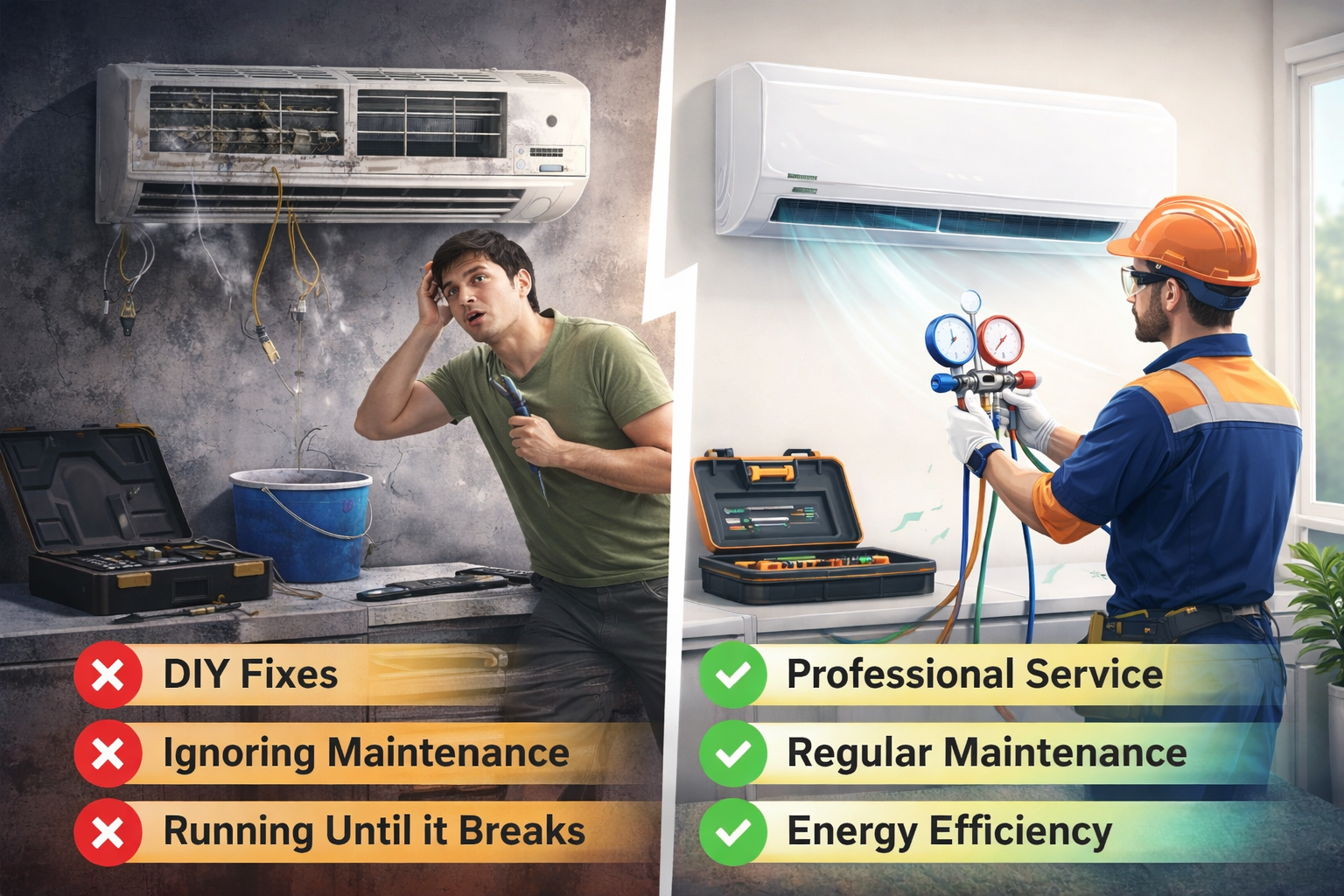
But anything involving refrigerant, electrical components, motor replacements or drainage system blockages beyond the basic drain pan is HVAC repair territory. Not because the tasks are impossible to learn, but because getting them wrong causes damage that far exceeds the cost of a professional callout. AC system repair done incorrectly can void warranties, cause refrigerant leaks and in worst cases create electrical hazards. Know what you can check. Know when to stop.
Air Conditioner Troubleshooting: What You Can Safely Check Before Calling a Pro
Before you call anyone, run through this. Air conditioner troubleshooting at the homeowner level is not about fixing the problem; it is about understanding it well enough to either rule out the simple stuff or describe it accurately to a technician.
- Check the filter first. Always.
- Check that the thermostat is set correctly and has working batteries.
- Look at your circuit breaker.
- Make sure the outdoor unit is not blocked by debris or vegetation.
- Check the drain pan under the indoor unit for water overflow.
These five steps take less than ten minutes and can save you an unnecessary service call or give you genuinely useful information when you do call. Common AC problems that seem complex often trace back to one of these five things.
AC Filters: The Most Overlooked Part of Routine Maintenance
Nobody thinks about their AC filter until something goes wrong. And by then, it is usually already contributing to the problem. A clogged filter does not just reduce airflow; it forces the evaporator coil to work harder, eventually causing it to freeze over. A frozen coil means no cooling. And a no-cooling situation that started with a dirty filter is one of the most avoidable AC system repair scenarios there is.
Air conditioner maintenance tips do not get more fundamental than this: Clean or replace your filter every four to six weeks if you are running your unit daily, especially in dusty environments. In the UAE, where dust accumulation is constant, this is not optional maintenance. It is the baseline. At AC Maintenance UAE, we see clogged filters as one of the most consistent root causes across callouts, and it is always one of the easiest things to prevent.
Closing Vents and Other Habits That Silently Damage Your AC
Closing vents in empty rooms seems logical. It is not. Your AC system is designed to distribute air across a specific pressure balance. Block part of that balance, and the pressure builds up in the ductwork, forcing the blower motor to work harder than it should.
Other silent damage habits include:
- Placing furniture directly in front of vents
- Leaving the outdoor unit in direct sunlight without clearance
- Running the system continuously without rest cycles
Why AC suddenly stop working after years of seemingly normal use often comes down to these accumulated habits rather than any single dramatic failure.
Air Conditioner Maintenance Tips That Prevent Costly Repairs
The best air conditioner repairs are the ones that never happen. That is not a clever line — it is genuinely how preventive maintenance works. Air conditioner maintenance tips are not about doing more. They are about doing a few consistent things well. The homeowners who rarely deal with unexpected breakdowns are not lucky — they are consistent.
How Often Should Your AC Actually Be Serviced
The standard answer is twice a year. The honest answer for UAE residents is every three months, and here is why that matters. The combination of extreme heat, heavy dust and sustained high-usage periods that define the UAE climate accelerates wear on every component of your system. Coils get dirty faster. Filters clog faster. Drain lines accumulate faster. HVAC repair intervals that work in cooler climates simply do not translate here.
At AC Maintenance UAE, we consistently see units that were serviced twice a year carrying the kind of wear that quarterly servicing would have caught well in advance. Pre-summer servicing before the peak months hit is not a precaution. In this climate, it is a necessity.
Small Habits That Prevent Major Air Conditioner Repairs
- Clean your filter every four to six weeks
- Keep a one metre clearance around your outdoor unit
- Set your thermostat to a consistent temperature rather than adjusting it constantly
- Schedule a professional check before summer
- Monitor your energy bills; an unexplained increase is almost always an early signal of something developing
None of these is difficult. None of them is expensive. But collectively, they are the difference between an AC that runs smoothly for fifteen to twenty years and one that needs significant air conditioner repairs every other season.
FAQs
Q1: What are the most common AC problems that homeowners mistake for major repairs?
Weak airflow, uneven cooling and slightly warm air are frequently mistaken for serious failures when they are often caused by a clogged filter, a tripped breaker or a minor refrigerant issue. Checking the basics first almost always reveals a simpler and cheaper explanation than expected.
Q2: Why is my AC not cooling even though it is running continuously?
A unit running without cooling is usually dealing with a dirty filter, a refrigerant leak or a frozen evaporator coil blocking proper heat exchange. Running continuously without cooling puts serious strain on the compressor, so the longer it goes unchecked, the more expensive the outcome.
Q3: Does an air conditioner consume refrigerant and need regular top-ups?
Refrigerant operates in a closed loop and does not get used up, so regular top-ups are not a maintenance requirement. If the level is low, that means there is a leak that needs to be located and fixed first. Topping up without addressing the source is a temporary patch that will need repeating within months.
Q4: Why does an AC unit suddenly stop working without any prior warning signs?
In most cases, the warning signs were present but went unnoticed, capacitor failure, frozen coils and clogged drain lines all build gradually before causing a full shutdown. The UAE’s extreme heat accelerates wear on these components considerably, making what feels sudden rarely without history.
Q5: How often should an air conditioner be professionally serviced to avoid costly repairs?
Twice a year is the general standard, but in the UAE, quarterly servicing is the more realistic answer given the extreme heat, constant dust and long high-usage periods. Servicing every three months means problems are caught while they are still inexpensive to fix.
Q6: Is it true that setting the thermostat lower cools the room faster?
A thermostat is a target temperature, not a speed control. Your AC cools at the same rate, whether it is set to 16 or 24 degrees. Setting it lower simply means the unit runs longer, resulting in higher energy bills and faster component wear.
Q7: What is the difference between HVAC repair and a full AC system repair?
HVAC repair refers to targeted fixes on specific components, such as a capacitor, motor or drain line, while a full AC system repair involves broader issues affecting the entire system, like compressor failure or major ductwork problems. Misidentifying one for the other is a common reason homeowners end up paying for the wrong fix.
Q8: At what point should I replace my AC unit instead of continuing with repairs?
If the repair cost exceeds 50 per cent of the price of a new unit, replacement is usually the smarter financial decision. Frequent breakdowns, rising energy bills despite servicing and compressor failure in units older than ten to twelve years are the clearest signs that replacement makes more sense than ongoing repairs.
Q9: Can a clogged air filter cause an AC unit to stop blowing cold air completely?
Yes, a severely blocked filter restricts airflow across the evaporator coil until it freezes over, after which the unit stops producing cold air entirely. What could have been resolved with a simple filter clean becomes a situation requiring a full shutdown and sometimes a professional inspection.
Q10: What daily habits can significantly extend the lifespan of an air conditioner?
Cleaning the filter every four to six weeks, setting the thermostat to a consistent temperature and keeping the outdoor unit clear of debris are the habits that make the biggest difference. Monitoring energy bills for unexplained increases and booking a professional check before summer will keep the system running efficiently for years longer.
The Bottom Line on Air Conditioner Repairs: Facts Win Every Time
Most air conditioner repairs are not random bad luck; they are the predictable result of ignored warning signs, believed myths and skipped maintenance. That is actually good news, because it means the majority of breakdowns are preventable. The pattern is consistent throughout this guide. Common AC problems like weak airflow, uneven cooling and rising energy bills are early signals, not minor quirks. Refrigerant does not run out on its own; it leaks, and that leak needs fixing. Bigger units do not cool better. Cranking the thermostat lower does not speed anything up. And a dirty filter is behind more AC system repair calls than most homeowners would ever guess.
The fix is not complicated. Follow basic air conditioner maintenance tips: clean filters regularly, schedule quarterly servicing in the UAE climate, keep your outdoor unit clear and stop the habits that quietly add wear. Do that consistently and your system will run longer, cost less and fail far less dramatically. If something still feels off after running through the basics, that is when a professional needs to take over. Here at AC Maintenance UAE, we have seen how catching things early before they turn into emergency callouts makes every difference. Getting the right diagnosis the first time is always cheaper than fixing the wrong one.