Most people only think about air conditioning when they’re already sweating. They buy a unit, book someone to fit it, and assume the rest takes care of itself. That’s where things go wrong.
Split air conditioner installation isn’t complicated, but it does require preparation. Skipping those steps costs real money. At AC Maintenance UAE, we see the same avoidable preparation mistakes repeatedly, and most of them are entirely preventable. This guide covers what the process actually involves, what it costs, and what you need to sort out before anyone shows up with a drill.
What Is a Split Air Conditioner and How Does It Work?
A split unit air conditioner is a two-part cooling system. One unit sits inside the room, one sits outside. They’re connected by a refrigerant line that runs through the wall. The indoor unit pulls warm air from the room, passes it over a cold evaporator coil, and pushes cooled air back out. The outdoor unit expels the heat. No magic, just physics.
Understanding this matters because the placement of both units directly affects performance. A poorly positioned indoor unit cools unevenly. A badly placed outdoor unit struggles to expel heat efficiently. Before any split air conditioner installation begins, knowing what you’re working with helps you ask better questions and make smarter decisions.
Key Split Air Conditioner Components You Should Recognise
- Evaporator coil: Sits inside the indoor unit, absorbs heat from room air
- Condenser: Located in the outdoor unit, it releases absorbed heat outside
- Compressor: The heart of the system, pressurises refrigerant to drive the cooling cycle
- Refrigerant line: Copper piping connecting the two units
- Drain pipe: Removes condensation produced during operation
- Air handler/blower: Circulates air across the evaporator coil inside the room
You don’t need to memorise all this. But knowing these split air conditioner components means you’ll understand what your installer is talking about and you’ll notice if something doesn’t sound right.
What Happens During a Split Air Conditioner Installation?
Here’s what a proper installation actually looks like, not the rushed version, the right one.
Site assessment comes first. The installer checks wall structure, pipe routing options, electrical supply, and drainage paths before anything else. At AC Maintenance UAE, our installation process always begins with a full site assessment before any drilling or mounting takes place. This step alone prevents most of the problems that come up later.
- Wall mounting follows. The indoor unit bracket is fixed at the correct height, typically 7 to 8 feet from the floor for even air distribution. An uneven mount causes vibration and noise over time.
- Drilling and pipe routing are next. A hole is made through the wall for the refrigerant line, drain pipe, and electrical cable. The routing path needs to be as short and direct as possible; longer pipe runs reduce efficiency.
- An electrical connection requires a dedicated circuit in most cases. The unit needs its own breaker, not a shared line. This is where a lot of DIY installations fall short.
- Vacuum testing and commissioning close it out. A professional air conditioner installation always includes a vacuum test on the refrigerant line to remove air and moisture before charging. Skip this, and you’re shortening the compressor’s life significantly.
DIY installation isn’t worth it. Most manufacturers void the warranty if the unit isn’t installed by a qualified technician. A wrong electrical connection is a fire risk. A poorly vacuumed line damages the compressor within months. The cost of fixing a bad installation is always higher than doing it right the first time.
How Much Does Split Air Conditioner Installation Cost?
The honest answer: it depends. But here’s a realistic breakdown of what you’re actually paying for.
The unit itself typically makes up the largest portion of the total split air conditioner cost. Capacity, brand, and energy rating all affect the price. A standard 1.5-ton unit sits in a different cost bracket from a 2.5-ton inverter model. Installation labour is separate from the unit price in most quotes. A standard single-split installation covers labour, pipe work, brackets, and electrical connection and varies by location, wall type, and pipe run length. Additional materials, such as extra copper piping, insulation, wall brackets, and drain extensions, add to the final figure depending on your specific setup.
What Affects the Final Installation Cost?
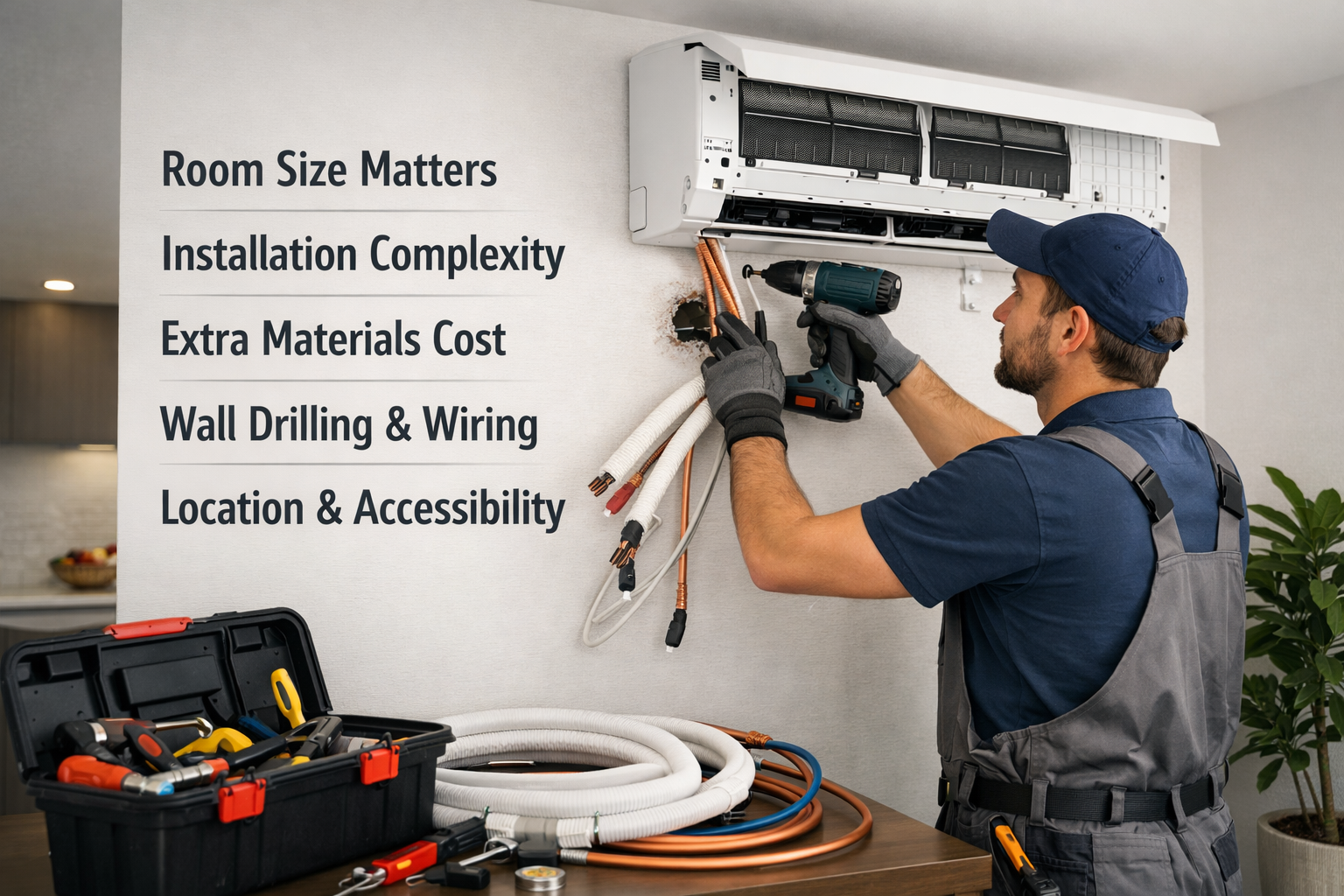
- Pipe run distance: Longer runs require more copper pipe and more labour
- Wall material: Drilling through concrete takes longer than brick or drywall
- Floor level: Higher floors often mean more complex outdoor unit positioning
- Single vs multi-split: Multi-split systems cost significantly more to install
- Brand and capacity tier: Premium inverter units have more complex requirements
- Electrical upgrades: A new dedicated circuit or upgraded breaker adds to the cost
Things to Check Before Your Installation Day
Getting this right on your end makes the whole process faster and cleaner.
- Wall load capacity: Confirm the wall can support the bracket and unit weight. Hollow partition walls sometimes need reinforcement
- Dedicated electrical circuit. Check whether your distribution board has a spare breaker slot. If not, your electrician needs to sort this out before installation day
- Drainage route: The drain pipe needs a clear path to an external drain. Plan this before the installer arrives, not during
- Indoor unit placement: Avoid positions directly above beds or desks where cold air blows directly onto people. Also, avoid walls with direct sunlight exposure for most of the day
- The outdoor unit surface needs a flat, stable surface with clear clearance on all sides. Confirm the location in advance
- Access for the installer: Clear the area around both installation points before the team arrives
A split unit air conditioner installed with proper preparation performs better from day one. These checks take an hour. Skipping them can cost half a day of delays.
Common Split Air Conditioner Installation Mistakes to Avoid
These aren’t rare edge cases; they come up constantly.
- Indoor unit too close to the ceiling or corners. It restricts airflow and creates uneven cooling
- Outdoor unit without adequate clearance. Blocked on multiple sides, it overworks and fails early
- No slope on the drain pipe. A flat or upward-running drain backs up and leaks into the wall or ceiling
- Direct sunlight on the outdoor unit increases ambient temperature, reducing efficiency and raising running costs
- Undersized electrical supply. Running a 2-ton unit on a circuit rated for less causes trips and potential damage
- Poor pipe insulation: Uninsulated refrigerant lines lose efficiency and cause water damage over time
- Skipping the vacuum test: Moisture in the refrigerant line degrades the compressor. This is the most commonly skipped step in rushed installations
These are the most common issues we’re called in to fix at AC Maintenance UAE, and in almost every case, they were avoidable from the start. A professional air conditioner installation covers all of these as standard. A cheap or rushed one doesn’t.
How to Choose the Right Unit Before Installation
Buying the wrong unit is expensive in two ways: upfront and ongoing. Too small and it runs constantly without cooling properly. Too large and it short-cycles, wearing out faster and leaving the room humid.
- Room size is the starting point. A rough guide: 1 ton of cooling capacity covers approximately 100–120 square feet under standard conditions. But ceiling height, sun exposure, insulation quality, and how many people use the room all shift that calculation.
- Energy rating matters more than most buyers realise. A higher-rated inverter model costs more upfront but adjusts its output based on demand; it doesn’t run at full power constantly. Over a few years in a warm climate, the running cost difference is significant.
- Brand reliability is a real factor. Some brands have better spare parts availability and local service support. That matters when something needs fixing three years down the line.
The wrong split unit air conditioner choice also directly affects your split ac cost over time. A unit that’s wrong for the space will either underperform or overwork, and both outcomes shorten its lifespan.
Frequently Asked Questions
Q1) How long does split air conditioner installation take?
A standard single-split installation typically takes three to five hours. Multi-split systems, longer pipe runs, or properties requiring electrical upgrades can extend this to a full day. A site assessment beforehand gives you a more accurate time estimate.
Q2) Can I install a split air conditioner myself?
Refrigerant handling requires qualification in most regions, and incorrect electrical connections are a genuine safety risk. Most manufacturers also void the warranty if installation isn’t carried out by a trusted technician. The cost of a professional air conditioner installation is always less than the cost of fixing a DIY one.
Q3) What are the main components of a split air conditioner?
The main split air conditioner components are the indoor unit (containing the evaporator coil and air handler), the outdoor unit (containing the compressor and condenser), the refrigerant line, the electrical supply cable, and the drain pipe. Each needs to be correctly installed to function properly.
Q4) How much does split air conditioner installation cost on average?
Split air conditioner installation cost varies based on unit capacity, pipe run length, wall type, and whether electrical upgrades are needed. Always request an itemised quote that separates unit cost from installation cost.
Q5) Does installation affect the warranty of my split unit air conditioner?
Yes significantly. Most manufacturers require installation by a qualified technician as a warranty condition. A split unit air conditioner installed without following the manufacturer’s specifications will typically have its warranty voided.
Q6) How far apart can the indoor and outdoor units be?
Most manufacturers recommend a maximum pipe run of 5 to 10 metres for standard residential installations. Longer runs are possible, but reduce efficiency and may require additional refrigerant. Always check the specific model’s technical documentation.
Q7) What electrical requirements are needed for installation?
Most split air conditioners require a dedicated circuit with its own breaker. Voltage requirements typically run 220 to 240V for residential systems. Earthing is mandatory. If your distribution board doesn’t have a spare slot or existing wiring is undersized, an electrician needs to address this before installation.
Q8) How do I know what size split unit air conditioner I need?
Start with 1 ton of capacity per 100 to 120 square feet. Adjust upward for high ceilings, south-facing rooms, or spaces with multiple heat sources. An undersized split-unit air conditioner will run constantly without ever properly cooling the room.
Q9) What is included in a professional air conditioner installation service?
A standard professional air conditioner installation covers indoor unit mounting, outdoor unit positioning, refrigerant line installation and insulation, electrical connection, drain pipe installation, vacuum testing, refrigerant charging, and full system commissioning. Always confirm what’s included in your quote.
Q10) How often should a split air conditioner be serviced after installation?
Every six to twelve months is the standard recommendation. In dusty environments or high-usage climates, every six months is preferable. Regular servicing after split air conditioner installation keeps filters clean, maintains refrigerant levels, and catches minor issues early.
Getting Your Installation Right From the Start
Preparation and professional installation determine how well your system performs and how long it lasts. The hardware matters. The placement matters. The process matters. A split air conditioner installation done the first time correctly saves you from repair calls, efficiency losses, and warranty disputes down the line. Know your components, check your space, and get an accurate itemised quote before committing to anything.
A thorough site assessment before anything else is what separates installations that last from ones that don’t. It’s the standard AC Maintenance UAE works to, and why most of their customers never need a callback.