Most AC problems in the UAE do not start with a broken compressor or a refrigerant leak. They start with a clogged, dirty AC filter that nobody noticed for months. Your air conditioner works harder, your electricity bill climbs, and the air quality inside your home quietly gets worse.
This guide covers everything homeowners and facility managers across the UAE need to know about AC filter cleaning: the different AC filter types available in the market, how to identify dirty AC filters before they cause damage, the right AC filter cleaning tools for the job, when to change AC filter versus when to clean it, and how to decide between a DIY approach and professional AC filter cleaning. By the end, you will have a clear, actionable maintenance plan suited to the UAE’s climate.
Why AC Filter Cleaning Matters more in the UAE
The UAE environment presents conditions that are uniquely demanding on air conditioning systems. Sand, fine desert dust, construction particulates, and high ambient temperatures combine to create a filtration challenge that is far more intense than what homeowners in temperate climates face.
Air conditioners in Dubai, Abu Dhabi, and Sharjah often run continuously for eight to ten months of the year. A filter that might stay reasonably clean for three months in a moderate climate can become heavily loaded in four to six weeks during summer in the UAE. This means that standard maintenance timelines from the manufacturer may not apply here.
Neglecting AC filter cleaning does not just reduce cooling performance. It forces the evaporator coil to freeze, restricts airflow to a dangerous level, and can shorten the lifespan of compressor components significantly. For a household appliance that runs almost year-round, that represents a serious financial risk.
A Complete Overview of AC Filter Types
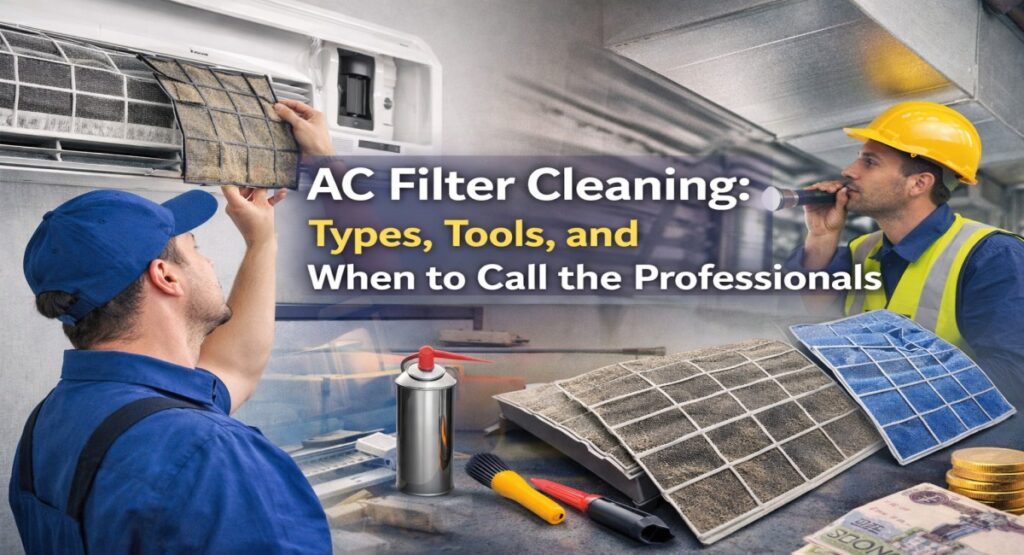
Before you can clean or replace a filter correctly, you need to understand which AC filter types are installed in your system. Different filter materials require different cleaning methods, and some cannot be washed at all.
Fiberglass Filters
Fiberglass filters are single-use, disposable panels made from layered glass fibers. They offer minimal filtration efficiency and are generally used in older split systems or industrial units. They cannot be washed and must be replaced once they accumulate dust. Their MERV rating typically falls between 1 and 4.
Polyester and Pleated Filters
Pleated polyester filters are among the most common AC filter types found in residential units across the UAE. Their accordion-like surface increases the filter area without increasing the frame size. Most pleated filters are washable to a limited degree, but repeated washing degrades their fibers and reduces efficiency over time. MERV ratings range from 5 to 13.
HEPA and Air Purification AC Filters
High-Efficiency Particulate Air (HEPA) filters represent the gold standard for air purification AC filters. They capture 99.97% of particles as small as 0.3 microns, making them highly effective against allergens, bacteria, and fine desert dust. True HEPA filters are generally not washable. They must be replaced according to a strict schedule, usually every 12 to 18 months in the UAE, depending on usage and environment.
Electrostatic Filters
Electrostatic filters use a static charge generated by airflow to attract and trap particles. They are available in both washable and disposable versions. Washable electrostatic filters are popular for UAE homeowners who want a reusable option with good filtration capability. However, they require thorough drying before reinstallation to prevent mold growth inside the unit, which is a genuine risk given the UAE’s humidity levels during certain seasons.
How to Identify Dirty AC Filters Before They Cause Damage
Recognizing dirty AC filters early is a skill that can save you from expensive repairs. The signs are usually visible and measurable if you know where to look.
- Reduced airflow from the vents: If the air coming out of your unit feels weaker than usual, a blocked filter is the first thing to check.
- Higher electricity bills: Dirty AC filters force the blower motor to work harder, consuming more power for the same output.
- Dust accumulation on furniture: If you are dusting more frequently than usual, the filter may be allowing particles to pass through or is so clogged that it is forcing dust back into the room.
- Musty or stale odors: Mold or bacterial growth on a saturated filter produces noticeable smells when the unit runs.
- System short-cycling or freezing: A severely restricted filter can cause the evaporator coil to ice over, leading to intermittent shutdowns.
If you experience any of these symptoms, inspect the filter immediately. Do not wait for the next scheduled maintenance visit.
When to Change AC Filter vs. When to Clean It
Understanding when to change the AC filter versus when a wash will suffice is one of the most practical questions homeowners face. The answer depends on the filter type, the condition of the filter, and the environment in which your unit operates.
Washable Filters: Cleaning Frequency in the UAE
For washable filters in residential split units operating in the UAE, the general recommendation is to clean every two to four weeks during peak summer months (May through September) and every four to six weeks in cooler months. If the unit serves a high-traffic area, a commercial kitchen, or a space with pets, increase the frequency accordingly.
A washable filter should be replaced rather than cleaned when the mesh shows physical tears, the frame is warped or cracked, or the material no longer springs back after washing. Even washable filters have a finite lifespan, typically one to three years, depending on usage and material quality.
Disposable Filters: Replacement Schedule
Disposable filters, including most fiberglass and HEPA variants, should never be washed. Attempting to wash them damages the filtration medium and introduces moisture into the unit. In the UAE, disposable filters in standard residential settings should be replaced every one to three months. Properties near construction sites or on sandy ground-floor units may need monthly replacement.
Essential AC Filter Cleaning Tools for an Effective Wash
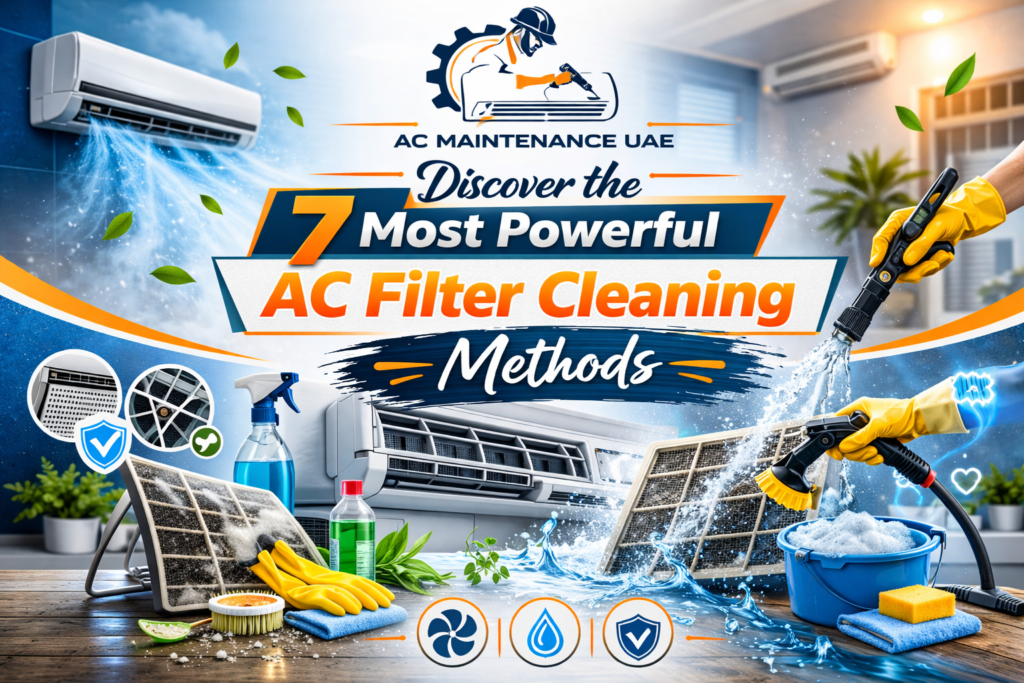
Having the right AC filter cleaning tools makes the process faster, more effective, and less likely to damage your filter. You do not need expensive equipment for routine residential maintenance.
- A soft-bristle brush: Used to gently dislodge dry dust from the filter surface before washing. Avoid stiff brushes that can tear delicate filter mesh.
- A handheld vacuum cleaner with a soft nozzle: Effective for removing loose dust before wet cleaning, especially for pleated filters with tight folds.
- Mild detergent or a purpose-made coil cleaner: Mix a small amount with lukewarm water. Avoid harsh chemicals that can break down filter materials or leave residues.
- A low-pressure spray nozzle or a handheld showerhead: Rinse from the clean side to the dirty side to push contaminants out of the filter rather than deeper into it.
- A clean, dry towel or microfibre cloth: For blotting excess moisture after rinsing.
- A shaded, well-ventilated area for drying: Never reinstall a damp filter. In the UAE, air-drying in the shade usually takes 30 to 60 minutes. Never use a hair dryer or direct sunlight, as heat can warp plastic frames.
For commercial or centralized systems, additional tools such as pressure washers set to low PSI and industrial coil cleaning sprays are commonly used by professional technicians.
How to Clean AC Filters: A Step-by-Step Process
Knowing how to clean AC filters correctly is straightforward once you understand the basic principles. Follow this process for washable residential filter types.
- Switch off the AC unit at the thermostat and the circuit breaker before opening any panels.
- Locate and remove the filter. In split units, the filter is behind the front panel of the indoor unit. In ducted systems, filters are typically inside the air handler or in return air grilles.
- Note the airflow direction marked on the filter frame before removal. You will need to reinstall it correctly.
- Use the soft brush or vacuum to remove dry surface dust. Do this outdoors or over a bin to avoid releasing particles indoors.
- Rinse the filter under lukewarm water. Start from the clean side (the side that faces the interior of the unit) to push dirt outward.
- Apply a small amount of mild detergent if the filter has visible grease or sticky residue. Gently work it in with a soft cloth or sponge, then rinse thoroughly.
- Shake off excess water and allow the filter to air dry completely in a shaded, ventilated location.
- Inspect the filter once dry. If you see tears, deformation, or persistent dark staining that does not wash out, replace the filter rather than reinstalling it.
- Reinstall in the correct airflow direction and restore power to the unit.
This process typically takes less than 30 minutes per unit. For homeowners with multiple split units across a villa or apartment, setting a calendar reminder every three to four weeks during summer is one of the easiest ways to stay on schedule.
When Professional AC Filter Cleaning is the Right Choice
DIY maintenance covers the basics well, but professional AC filter cleaning offers advantages that go beyond what a homeowner can reasonably achieve with standard tools.
Professional technicians do not just clean filters. During a service visit, a qualified technician inspects the evaporator coil, checks the drain pan and condensate line for blockages, verifies refrigerant levels, and examines electrical connections. This comprehensive approach means that problems adjacent to the filter are identified and addressed before they develop into failures.
For centralized air systems, ducted villas, or commercial properties in the UAE, professional cleaning is essentially non-negotiable. The duct network itself accumulates dust and biological contaminants that a filter change alone cannot address. Professional duct cleaning combined with filter replacement ensures that air purification AC filters installed in the system are actually delivering the quality they are rated for.
AC Maintenance UAE provides dedicated filter inspection, cleaning, and replacement services across Dubai, Abu Dhabi, and the surrounding Emirates. Their technicians are trained to handle all residential and commercial AC filter types, including split systems, cassette units, ducted systems, and central plant rooms. For properties with air purification AC filters such as HEPA or activated carbon variants, AC Maintenance UAE carries manufacturer-approved replacements to ensure compliance with warranty terms.
Air Purification AC Filters: Upgrading for Better Indoor Air Quality
Standard filters are designed to protect the AC unit itself, not necessarily to improve the air you breathe. Air purification AC filters are specifically designed to remove contaminants that affect human health, including fine particulates, allergens, volatile organic compounds (VOCs), and airborne pathogens.
In the UAE, where occupants spend a large portion of their time indoors due to extreme outdoor heat, indoor air quality has a direct impact on respiratory health, sleep quality, and allergy management. Upgrading to a HEPA or combination HEPA-carbon filter in your existing unit can significantly reduce exposure to fine dust, pollen, and odor-causing compounds.
Before upgrading, confirm that your AC unit can handle the increased static pressure that comes with denser air purification AC filters. Installing a filter with a MERV rating that is too high for your system’s blower can actually worsen performance and accelerate motor wear. A qualified technician from AC Maintenance UAE can assess your system and recommend the highest-rated filter that your unit can safely support.
Building a Practical AC Filter Maintenance Schedule for UAE Properties
A consistent schedule is more valuable than any single cleaning session. The following general framework suits most UAE residential properties.
- Every 2 to 4 weeks (May to September): Inspect and clean washable filters in all active split units.
- Every 4 to 6 weeks (October to April): Inspect and clean washable filters. Replace disposable filters if due.
- Every 3 months: Schedule a professional inspection for ducted or centralized systems. Check drain lines, coils, and thermostat calibration.
- Every 12 to 18 months: Replace HEPA and high-efficiency air purification AC filters. Have ductwork inspected and cleaned if needed.
Documenting your maintenance activity, including dates cleaned, filter type, and any observations, gives you a useful reference for spotting patterns and planning for when to change AC filter components.
Frequently Asked Questions
How often should I do AC filter cleaning in the UAE?
For residential split units running throughout the summer, clean washable filters every two to four weeks. In cooler months, every four to six weeks is sufficient. Properties near construction zones or in high-dust areas should be cleaned more frequently.
What are the most common AC filter types in UAE homes?
Pleated polyester filters are the most widely used in UAE split units. Electrostatic washable filters and HEPA air purification AC filters are also available and increasingly popular in villas and apartments where indoor air quality is a priority.
When should I change the AC filter instead of cleaning it?
Replace the filter rather than clean it when you see physical tears, warped frames, or persistent discoloration that does not respond to washing. Disposable filters such as fiberglass and HEPA should always be replaced, never washed.
Can dirty AC filters cause health problems?
Yes. Dirty AC filters can harbor mold, bacteria, and accumulated allergens. When the unit runs, these are distributed through the air you breathe indoors. This can worsen asthma, trigger allergies, and reduce overall air quality in your home or office.
What AC filter cleaning tools do I need at home?
The essentials are a soft-bristle brush, a handheld vacuum with a soft nozzle, mild detergent, lukewarm water, and a shaded drying area. These tools are sufficient for standard residential filter cleaning without professional equipment.
Are air purification AC filters worth installing in UAE homes?
For households with allergy sufferers, young children, or elderly residents, air purification AC filters such as HEPA variants offer meaningful benefits. Given how much time UAE residents spend indoors due to the heat, investing in better filtration is a practical health decision.
What happens if I run my AC with a clogged filter?
Running the AC with a clogged filter restricts airflow, which can cause the evaporator coil to freeze, the compressor to overheat, and the unit to short-cycle or fail. Energy consumption also increases significantly even as cooling output decreases.
Does AC Maintenance UAE offer filter replacement and cleaning services?
Yes. AC Maintenance UAE provides professional AC filter cleaning, inspection, and replacement services for residential and commercial properties across Dubai, Abu Dhabi, and the wider UAE. They handle all major AC filter types and carry manufacturer-approved replacements for HEPA and specialty filters
Conclusion
AC filter cleaning is not a complex task, but it is one of the most impactful maintenance habits a UAE homeowner or facility manager can develop. Choosing the right AC filter types, cleaning them on a schedule that reflects the UAE’s demanding climate, using the proper AC filter cleaning tools, and knowing when to change AC filter components versus when a wash will do, makes a measurable difference to system performance, energy costs, and indoor air quality.
For properties where professional AC filter cleaning is needed, or where upgrading to air purification AC filters makes sense, AC Maintenance UAE offers experienced, reliable service across the Emirates. Reach out to their team to book an inspection or set up a scheduled maintenance contract that keeps your system running cleanly and efficiently all year long.